Resources
- Slides: Factor Analysis, Cluster Analysis, Conjoint Analysis
- Exercises: Factor Analysis, Cluster Analysis, Conjoint Analysis
Factor Analysis
Factor analysis is a statistical method used to identify underlying relationships, factors influencing covariation between observed variables. It reduces data dimensionality by grouping correlated variables into factors, which represent latent constructs.
Factor analysis refers both to the approach and a technique. Exploratory factor analysis is used to discover the underlying factor structure without prior hypotheses, while confirmatory factor analysis tests specific hypotheses about factor structures. Principle Component Analysis (PCA), however, provides a summary of a dataset’s correlational structure and allows for a mathematical transformation of the original variables into a smaller set of uncorrelated components, making it the standard technique for data reduction.
Latent Construct
A latent construct is an unobserved variable that influences observed variables. For example, “intelligence” is a latent construct that may influence test scores.
Suitability of Data for Factor Analysis
To conduct the factor analysis, the variables should be at least interval-scaled and approximately normally distributed. There should be multiple intercorrelations of .3 or higher among the variables to justify the analysis. In general, there should be at least 10 observations per variable and 4 variables per factor. Parameters become stable around 300 observations. With large communality, smaller samples may be sufficient.
Two tests can be used to assess the suitability of the data for factor analysis:
Bartlett's Test of Sphericity
Tests the null hypothesis that the correlation matrix is an identity matrix. A significant result (p < .05) indicates that there are sufficient correlations among variables to proceed with factor analysis.
Kaiser-Meyer-Olkin (KMO) Measure of Sampling Adequacy
Indicates the proportion of potentially common variance among variables. Values range from 0 to 1, with values above 0.6 generally considered acceptable for factor analysis.
\frac{ \sum_{j \neq k} \sum r_{jk}^2 }{ \sum_{j \neq k} \sum r_{jk}^2 ;+; \sum_{j \neq k} \sum p_{jk}^2 }
where $r_{jk}$ are the correlations between variables $j$ and $k$, and $p_{jk}$ is the correlation between $j$ and $k$ after all other variables have been partialled out.
Principle Component Analysis (PCA)
PCA is a technique of factor analysis that works with linear combinations of observed variables to create components that explain the maximum variance in the data. Each component is a weighted sum of the original variables, with weights determined by the eigenvectors of the correlation matrix. The first component explains the most variance, the second component explains the most of the remaining variance, and so on. Components are uncorrelated with each other.
Extraction of Factors
To determine the components to extract, we compute the eigenvalues and eigenvectors of the correlation matrix of the observed variables. The eigenvectors represent the directions of maximum variance (the components), and the eigenvalues indicate the amount of variance explained by each component.
The process was not further detailed mathematically here, but it’s solving the characteristic equation of the correlation matrix.
Determining Number of Factors to Keep
Several methods exist to determine the number of factors to retain in PCA:
- Kaiser Criterion: Retain factors with eigenvalues greater than 1.
- Scree Test: Plot the eigenvalues and look for an “elbow” point where the slope of the curve changes, indicating diminishing returns for additional factors. This approach is subjective.
- Parallel Analysis: Compare the eigenvalues from the actual data to those obtained from random data of the same size. Retain factors where the actual eigenvalue exceeds the random eigenvalue.
Eigenvalue Matrix
The eigenvalue matrix contains the eigenvalues associated with each principal component. Each eigenvalue represents the amount of variance in the data, across all variables, explained by its corresponding component. An eigenvalue greater than 1 indicates that the component explains more variance than a single observed variable.
where is the diagonal matrix of eigenvalues, is the matrix of eigenvectors (V’ transposed), and is the correlation matrix of the observed variables.
Eigenvalues
Eigenvalues are scalars associated with a linear transformation that indicate how much the transformation stretches or compresses vectors in a given direction. In the context of PCA, eigenvalues represent the amount of variance explained by each principal component.
Factor Loadings Matrix
The factor loading matrix shows the correlations between observed variables and the extracted factors. High loadings indicate that a variable is strongly associated with a factor. It’s determined by the eigenvalue matrix:
where is the factor loading matrix, is the matrix of eigenvectors, and is the diagonal matrix of eigenvalues.
- Factor Loading : The correlation coefficient between an observed variable and a factor, indicating the strength and direction of their relationship.
- Communality : The proportion of an observed variable’s variance explained by the common factors.
- Uniqueness: The proportion of an observed variable’s variance not explained by the common factors; the information lost when reducing dimensions.
Factor Rotation
Variables may contribute to multiple factors, making interpretation difficult. Factor rotation helps with interpretation by maximizing high loadings and minimizing low loadings. When factors are rotated, the variables’ loadings on the factors are changed, but the overall fit of the model remains the same.
Geometric Representation
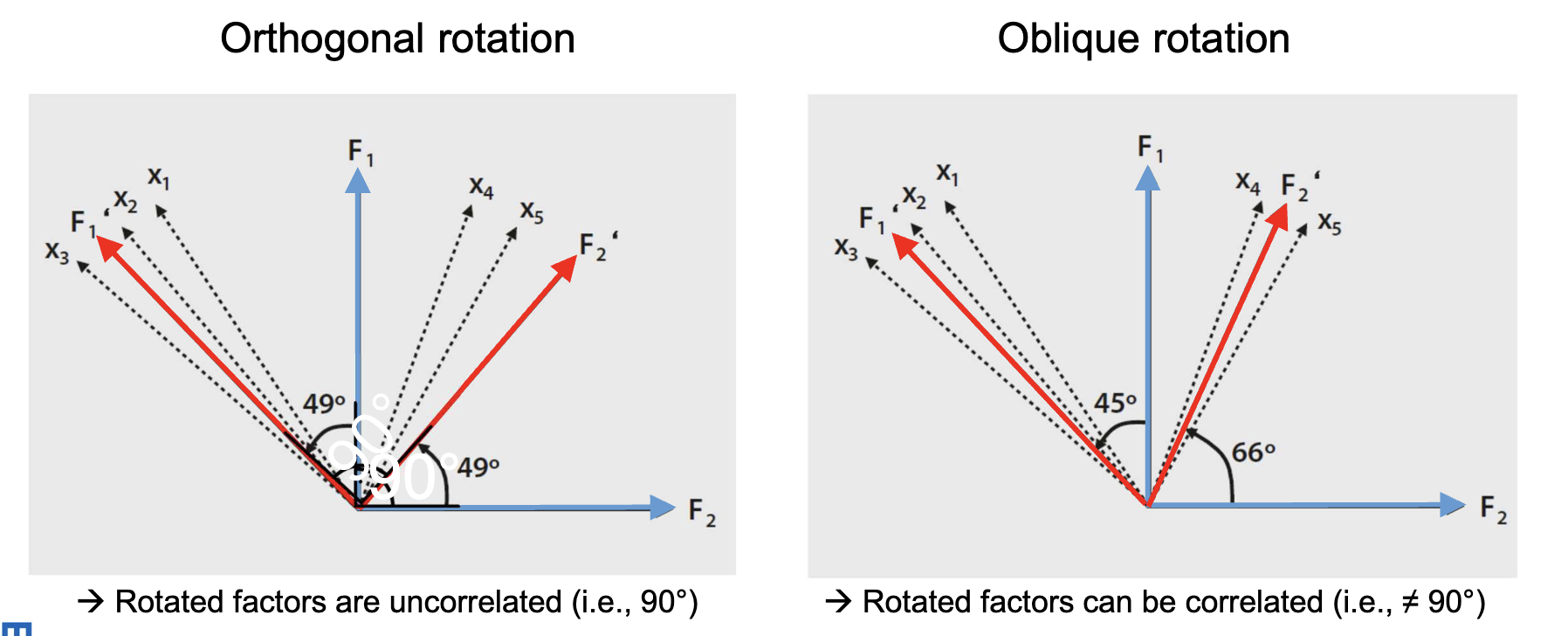
When representing factors as vectors, their correlation is the cosine of the angle between them. Orthogonal rotation keeps factors uncorrelated (90° angle), angles smaller than 90° indicate positive correlations, and angles larger than 90° indicate negative correlations. ((p. 21)) During rotation, the angles between factor axes change, and the factor loadings change accordingly. However, the lengths of the factor vectors (which determine communalities) and the total variance explained are preserved.
Orthogonal Rotation
Rotating orthogonally keeps factors uncorrelated. Choose this if the theory suggests that factors should be unrelated. Common methods include Varimax, Quartimax. Here, the axes of the factors are rotated while maintaining a 90° angle between them. Interpretation is based on structure loadings, which represent the total correlation of each factor with each variable.
- Varimax: Maximizes the variance of squared loadings across the variables within each factor.
- Quartimax: Maximizes the variance of squared loadings across factors for each variable.
Oblique Rotation
Oblique rotation allows the resulting factors to be correlated, reflecting real-world concepts that often relate. Common methods include Direct Oblimin, Promax. Here, the axes of the factors can take any angle relative to each other. Interpretation is based on pattern loadings, which represent the unique contribution of each factor to each variable.
- Oblimin: Minimizes the cross-loadings of variables on multiple factors.
- Promax recommended: Based on varimax rotation, but using exponentiated factor loadings to accentuate loading differences.
Factor Interpretation
After rotation, factors are interpreted based on the variables with high loadings. A common threshold is a loading of 0.4 or higher. Variables with high loadings on a factor are considered to contribute significantly to that factor, and a subjective judgement is made to label the factor based on the common theme among these variables.
Factor Scores
Factor scores represent each observation’s position on the latent factors. They are computed as factor load-weighted variable combinations and can be used in further analyses to compare observations or examine relationships between factors and other variables.
Self-Test
Factor Analysis
- What are the goals of factor-analytic techniques?
- What do eigenvalues in a principle component analysis (PCA) represent?
- What is the key idea underlying the scree test? What is the purpose of parallel analysis?
- What are factor loadings? What is meant by uniqueness and how is it related to communality?
- Why is it usually useful to conduct a rotation of the extracted factor solution?
- What is the difference between orthogonal and oblique rotation?
- What are factor scores?
- What is measured with the Bartlett‘s test and the KMO test and what results of these tests are desirable?
- Give two rules of thumb when planning the sample size for a PCA