Resources
Entrepreneurial Character
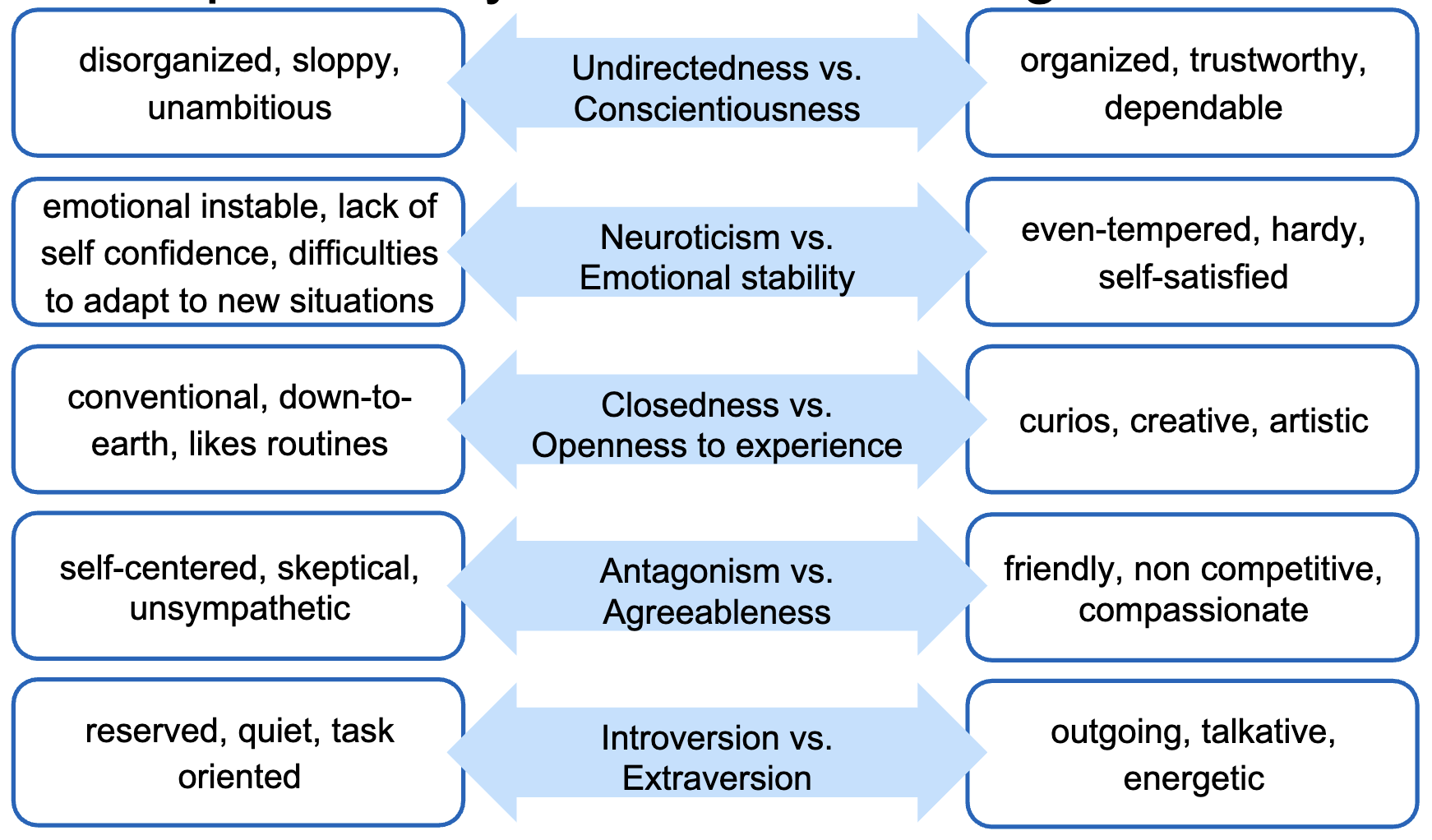
The Big Five Personality Traits
- Conscientiousness: Organized, dependable, trustworthy, higher for entrepreneurs, positive on business creation, positive on performance
- Neuroticism: Emotionally unstable, not self-satisfied or even-tempered, lower for entrepreneurs, negative on business creation, negative on performance
- Openness to Experience: Curious, creative, open to new perspectives, higher for entrepreneurs, positive on business creation, positive on performance
- Agreeableness: Friendly, compassionate, collegial, lower for entrepreneurs, negative on business creation, not significant on performance
- Extraversion: Outgoing, energetic (no significant difference between entrepreneurs and managers), positive on performance
Meta-Analytic Findings: Big Five & Entrepreneurship
| Construct | Effects on Business Creation | Effects on Business Performance |
|---|---|---|
| Conscientiousness | Entrepreneurs higher than managers: rₑ = .22; K = 20; N = 3,480 (Zhao & Seibert 2006) | rₑ = .19; K = 24; N = 3,193 (H. Zhao et al. 2010) |
| Neuroticism | Entrepreneurs lower than managers: rₑ = –.18; K = 14; N = 2,305 (Zhao & Seibert 2006) | rₑ = –.18; K = 29; N = 4,446 (H. Zhao et al. 2010) |
| Openness | Entrepreneurs higher than managers: rₑ = .10; K = 10; N = 2,115 (Zhao & Seibert 2006) | rₑ = .21; K = 15; N = 2,461 (H. Zhao et al. 2010) |
| Agreeableness | Entrepreneurs lower than managers: rₑ = –.08; K = 7; N = 1,350 (Zhao & Seibert 2006) | Not significant (H. Zhao et al. 2010) |
| Extraversion | Not significant (Zhao & Seibert 2006) | rₑ = .09; K = 9; N = 1,476 (H. Zhao et al. 2010) |
K: number of included studies in a meta-analysis; N: overall sample size; rₑ: (corrected) correlation coefficient indicating the strength and direction of the relationship between two variables; interpretation of sizes in the social sciences (Cohen, 1988): 0.1 = small effect; 0.3 = medium effect; 0.5 = large effect
Slide 12
Motives
Internal forces that push people into certain actions
Need for Achievement
- Preference for high (internal or external) standards, desire for success, engagement in task-oriented behavior
Need for Autonomy
- Preference for making decisions independently, setting one’s own goals, being in control, avoidance of restrictions
Meta-Analytic Findings: Motives & Entrepreneurship
| Construct | Effects on Business Creation | Effects on Business Performance |
|---|---|---|
| Achievement motivation | r = .21; K = 41; N = 5,814 (Collins et al. 2004) | rₑ = .30; K = 31; N = 4,115 (Rauch & Frese 2007) |
| rₑ = .22; K = 29; N = 8,698 (Rauch & Frese 2007) | ||
| Achievement facet of conscientiousness: rₑ = .28; K = 17; N = 3,005 (Zhao & Seibert 2006) | ||
| Autonomy | r = .31; K = 11; N = 4,256 (Rauch & Frese 2007) | rₑ = .16; K = 8; N = 843 (Rauch & Frese 2007) |
r/rₑ like above; Slide 14
Risk-Taking Propensity
The willingness to pursue actions with uncertain outcomes. Entrepreneurs show slightly higher risk-taking propensity than managers.
Brain vs. Heart
Individual-level capabilities influencing entrepreneurial behavior, similar to IQ/EQ:
- General Mental Ability (GMA): cognitive capabilities like reasoning, problem-solving, learning
- Emotional Intelligence (EI): recognizing, understanding, managing emotions in oneself and others
GMA and EI are important for entrepreneurial success, though the relationship is more than twice as large for EI.
Positive Affect
Positive affect influences cognitive processes, impacting entrepreneurial process and outcomes (e.g., attracting stakeholders, responding to dynamic environments).
- Triggers global perception: seeing the big picture
- Leads to less careful information processing
- Mood-congruent memory: memories are filtered by mood
- Health benefits are connected to larger support networks
Entrepreneurial Passion
- Passion for entrepreneurial activity leads to Positive Affect.
- Identifying with the venture increases passion, which drives persistence.
- Obsessive passion can have negative effects (e.g., feeling bad when not working, not accepting feedback).
Additional Notes
- Personality traits are stable over time, influenced by genetics and childhood experiences.
- Traits relate to broad personality factors, temperament, motives, attitudes, and beliefs.
- Even if some characteristics facilitate entrepreneurship, there is no deterministic relationship.
- Awareness of one’s strengths and weaknesses helps in role selection, team composition, and strategy choice (p. 16).