Resources
Development of Relationship Models (p. 8)
- Past decades (Input-outcome models): Explored relationships between (easily observable) team characteristics and venture performance (Strategic Management).
- 2000s (Input-mediator-outcome models): Provided more precise insights into the relationship of team inputs and team/venture outcomes (Organizational Behavior).
- 2010s (More nuanced models): Take into account complexities of entrepreneurial teams, such as the team and the venture life cycle (Entrepreneurial Behavior).
Input-Mediator-Outcome Framework (p. 9)
- Inputs: Team members’ prior experiences, social capital, personality.
- Mediators:
- Team processes: Conflict, team decision-making, planning.
- Team emergent states: Team cognition, cohesion, psychological safety.
- Outcomes: Venture performance, venture growth, innovativeness.
Team Composition
The entrepreneurial team journey involves finding members, setting up the team, and managing the team. (p. 10)
Most European startups are founded by teams, most commonly consisting of two or three co-founders. (p. 7)
Heterogeneity & Homogeneity
Team members can be similar or different in various attributes, classified as homogeneous and heterogeneous teams. (p. 11)
Homogeneous Teams
Teams where members share similar characteristics, backgrounds, skills, or perspectives.
Benefits: Easier communication, faster decision-making, stronger cohesion.
Challenges: Risk of groupthink, limited creativity, and innovation.
Heterogeneous Teams
Teams where members have diverse characteristics, backgrounds, skills, or perspectives.
Benefits: Enhanced creativity, broader skill set, diverse perspectives.
Challenges: Potential for conflict, communication barriers, longer decision-making processes.
Prior Ties
Teams can be formed based on existing relationships or new connections, classified as strong ties and weak ties.
Strong Ties (p. 14)
Relationships characterized by frequent interaction, emotional closeness, and mutual trust. This is more common: Friends, family, former colleagues.
Benefits: Often more psychologically safe, build on joint values for the firm’s culture, avoids relational uncertainty.
Challenges: Learn to distinguish between relationship and task conflict, reflect on old and new roles, speak early about changes in team composition, and ensure to include others (e.g., future employees).
Weak Ties (p. 15)
Relationships characterized by infrequent interaction, low emotional closeness, and limited trust.
Benefits: Flexibility in finding partners, maximize human capital, bring in new perspectives, diverse skills, and broader networks.
Challenges: Need to understand others’ values and vision, define the relationship and its potential transformations, discuss rules and roles to establish fairness and trust, and consider introducing rituals or routines.
Co-Founder Agreement
A formal document outlining the roles, responsibilities, equity distribution, decision-making processes, and conflict resolution mechanisms among co-founders. (p. 16)
It can professionalize strongly tied relationships and structure weakly tied relationships.
Working on the venture:
- What are everyone’s values, goals, and visions? What do they want to build?
- What does high performance mean?
- How to present the firm to the outside, per stakeholder?
Working together:
- Roles and responsibilities; who takes care of less comfortable tasks?
- Decision-making processes, voting/consensus, deadlocks?
- How to measure contributions; who has contributed what?
- How to ensure expected contributions and reward/sanction?
Future:
- Building up and integrating new competencies.
- Exit scenarios, buy-sell agreements, breakup scenarios.
- When and how this agreement should be reviewed.
Useful Resource
Equity Distribution
Typically, teams split quickly and agree on an equal split. Negotiations about equity are often emotional and stressful and may be avoided to preserve the relationship. Besides money, power and control are crucial issues. (p. 17)
This is the “first deal” for entrepreneurs. For static splits and digital platform development, foundrs.com is a useful starting point. (p. 22)
Temporal Orientation
The split can be based on past or future contributions. (p. 18)
Backwards Orientation
Focuses on past contributions, providing more certainty (though not necessarily agreement).
Primary factors:
- Idea Premium
- Capital Contribution
- Opportunity Costs
Forwards Orientation
Focuses on future contributions. When equity is split, most of the work required for success is still ahead.
Primary factors:
- Prior Experiences, Skills & Networks
- Level of Commitment
- Titles
Timing
The split can be decided at the beginning of the venture or after some time. (p. 19)
Early Split
An earlier split can be attractive for new team members by providing equity incentives. It’s suitable when there’s previous work experience (together) and time for calm negotiation.
Later Split
A later split allows for more information about contributions and commitment to be gathered. The business model and roles can form over time, and renegotiations after fundamental changes are not necessary.
Static & Dynamic Split
A static split assigns equity once, while a dynamic split allows for adjustments over time. (p. 20)
A former co-founder who still holds a major part of the equity can endanger the venture, which is highly unattractive for investors. A dynamic split can solve this.
Vesting
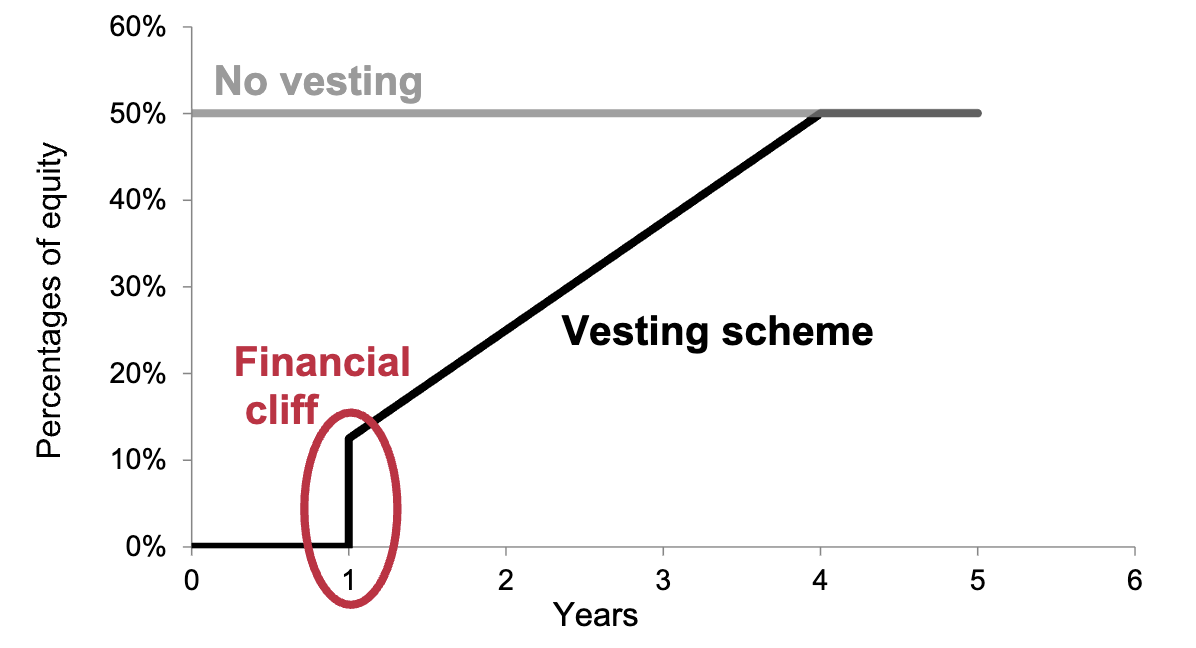
Helps split equity fairly over time: Founders need to earn equity stakes, based on time or milestones. While not perfect, it offers protection for all team members if a member leaves early, as the unvested portion can be reallocated.
Example: Time-based vesting over 4 years with a 1-year cliff. No equity is earned in the first year; after one year, 25% is vested, and the remaining 75% vests monthly over the next three years. (p. 21)
Conflict Management
Conflicts are inevitable in teams, especially in high-stress environments like startups. Effective conflict management is crucial for maintaining team cohesion and productivity.
Determining if a conflict is worth fighting for
| Principle | Guiding Question | Meaning |
|---|---|---|
| Relevance | Matters for future success? | Affects venture trajectory, not just preferences; creates lasting values or prevents risk |
| Future Focus | Fighting about what could be, not what went wrong? | Discussion on strategy, vision, innovation; not blaming or revisiting past mistakes. |
| Noble Purpose | Connects to something bigger than individual interests? | Serves customers or mission; not ego, power, ownership. |
Example: (p. 27)
Types of Conflict
Task Conflict
Disagreements about the content of the team tasks, including differences in viewpoints, ideas, and opinions. This type of conflict can be beneficial as it can increase the exchange of ideas, decision quality, and venture performance.
Task conflicts are at risk of spilling over and escalating into relationship conflicts if not managed properly. (p. 25)
Relationship Conflict
Interpersonal incompatibilities among team members, leading to tension, animosity, and annoyance. This type of conflict is generally detrimental as it reduces trust, cooperation, and venture performance.
Vision Congruence
Ensuring all team members share a common vision for the venture is crucial. Misalignment can lead to conflicts that hinder progress. The interplay between vision congruence and opportunity development style impacts venture outcomes. (p. 24)
Vision Congruence
All team members share a similar vision for the venture.
They tend to be more focused. Their major challenge is committing to a single product and market, often leads to a lack of proactivity (project implosion).
They required proactivity to succeed (coming up with novel solutions).
Vision Incongruence
Visions for the project diverge in a way that is incompatible to achieve in the same venture.
These teams tend to be more broad. They often face the challenge of following to many different leads (project explosion).
They required professionalism to succeed (detailed agendas, minutes, defined roles).
Strategies to Enhance Vision Congruence
- Regularly revisit and discuss the venture’s vision and goals.
- Encourage open communication about individual aspirations and how they align with the venture.
- Celebrate milestones that reflect the shared vision to reinforce commitment.