Resources
These notes use the first exponent of the Cobb-Douglas production function as the labor share , and the second exponent as the capital share . While non-standard, this was more useful to me during the lectures.
Economic Growth
This chapter analyzes how output develops over time; the long-run growth of the economy. In this simple version, government policies are not considered, and the economy is closed (no trade with other countries). The most common model is the Solow Growth Model, which focuses on capital accumulation, labor or population growth, and increases in productivity, commonly referred to as technological progress.
- Output is determined by the production possibilites (production function and inputs labor and capital)
- Output is used for consumption and investment , where investment equals savings sY in a closed economy. is the savings rate.
- Savings are invested in the capital stock
We assume these conditions, which allow us to use the intensive form:
- The production function has constant returns to scale:
- The production function exhibits diminishing returns positive to each input
- The production function follows the Inada conditions, defining the behavior of marginal returns at extreme values of inputs
Intensive Form of the Production Function
By dividing the production function by labor , we can express output per worker (intensive form):
Where is the output per worker, and is the capital per worker. The function has the same properties as : constant returns to scale, diminishing returns, and Inada conditions.For Cobb-Douglas Functions : The intensive form of the production function is
Population Growth
Per period , the labor force grows at a (positive or negative) rate :
Capital Accumulation
Per period , a fraction of output is invested in the capital stock, while a fraction of the capital stock depreciates:
Capital per Worker
Capital per worker increases with savings and decreases with depreciation and population growth. The transition equation is:
This shows that the capital available for workers in the next period depends on the current capital stock, the investment from current output, and the reduction from wear and tear.
Steady State
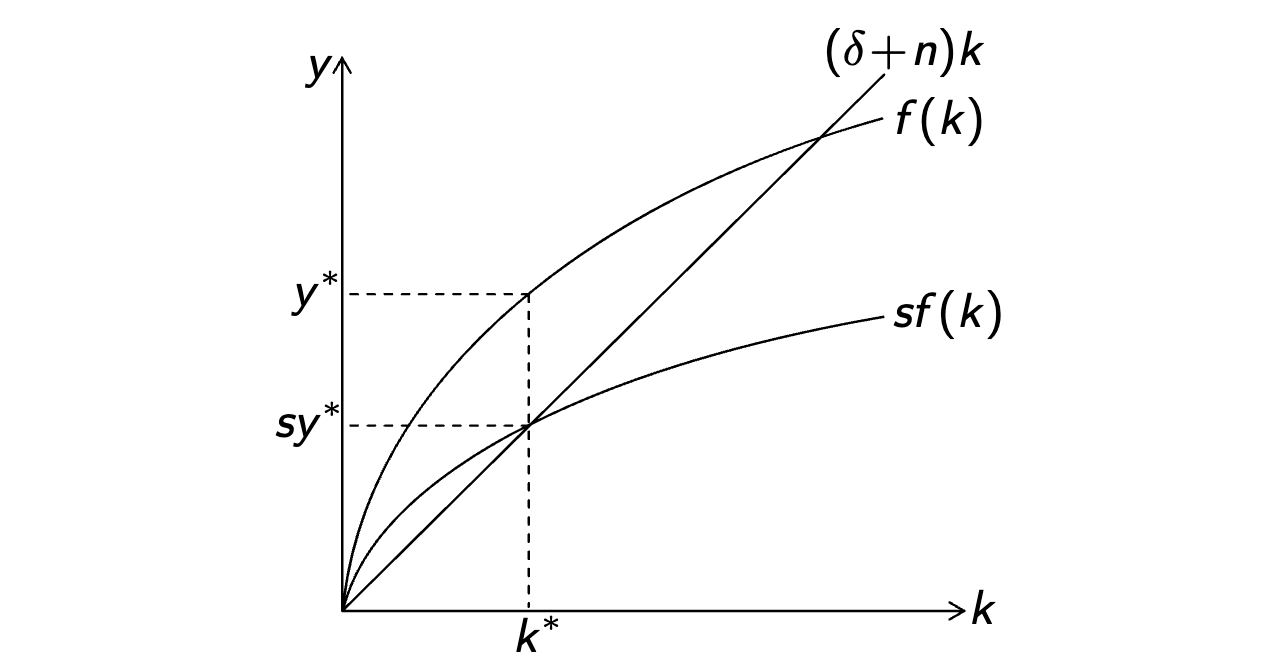
When capital per worker stays constant, investments per worker (savings) must equal the decrease in capital per worker due to depreciation and population growth.
In such a case, the economy is in a steady state. Here, is the steady-state level of capital per worker, is the depreciation rate of capital, and is the population growth rate.
Steady State Consumption
In any period , consumption per worker is the portion of output not saved:
In the steady state, because , we can rewrite the consumption per worker as:
Convergence
When the economy is not in a steady state, capital per worker will either increase or decrease over time until it reaches the steady state . This process is known as convergence.
If capital per worker is below the steady state level , saivings exceed depreciation and population growth, leading to an increase in capital per worker over time ( increases). On the other hand, if , depreciation and population growth exceed savings, causing capital per worker to decrease over time ( decreases).
Determinants of the Steady State
- Higher Saving Rate (): Increases due to more output funneled into investment, rather than consumption.
- Higher Depreciation (): Decreases due to faster capital wear and tear, requiring more investment to maintain the capital stock.
- Higher Population Growth (): Decreases as more workers dilute the capital stock, necessitating more investment to keep up.
Golden Rule: Maximizing Consumption
While any saving rate can lead to a steady state, the Golden Rule identifies the specific level of capital that maximizes consumption per worker . Therefore, the objective is:
Which is maximized when:
which is the same as (see steady state consumption):
Where is the marginal product of capital at the Golden Rule level, equal to the sum of depreciation and population growth rates. This occurs when the production function line is tangent to the break-even investment line.
Efficiency Trade-Offs
- Dynamic Inefficiency: If the saving rate exceeds its golden rule level , the economy is saving too much, reducing consumption increases consumption both now and in the future.
- Dynamic Efficiency: If the saving rate is less than its golden rule level , the economy is saving too little, increasing savings increases consumption in the future, although it reduces consumption now.
Cobb-Douglas Shortcut
For Cobb-Douglas Production functions , the Golden Rule level of capital per worker can be directly calculated as:
The corresponding consumption is:
And the saving rate that achieves the Golden Rule level of capital per worker is:
This means that in a Cobb-Douglas economy, the saving rate that maximizes consumption per worker is equal to the output elasticity of capital .
The first two shortcuts apply to all Cobb-Douglas steady states when using .
Technological Progress
Technological progress leads to increases in productivity to sustain growth of output per worker over time. Therefore, the standard Labor force is replaced by the effective labor force , where represents the workers’ productivity.
The production function becomes:
Productivity Growth
Productivity is assumed to grow at a constant rate per per period . In steady state, the capital stock per worker therefore also grows at rate :
Extended Steady State
When technological progress is involved, the Steady State no longer implies constant capital per worker , but rather constant capital per effective worker . The output per worker and capital per worker will grow at the rate of technological progress in the steady state.
In extended steady state, the break-even investment must now also account for productivity growth:
Extended Golden Rule
With technological progress, the Golden Rule condition for maximizing consumption per worker becomes:
Growth Rates Summary
| Variable | Growth Rate (No Tech Progress) | Growth Rate (With Tech Progress g) |
|---|---|---|
| Output per worker ()** | ||
| Capital per worker ()** | ||
| Total Output ()** | ||
| Total Capital ()** |
Example Problem
These are the market macroeconomic indicators problem from exercise exam 1 with some questions from exercise 6 and exercise exam 2.
An economy is described by its production function:
In any period labor force grows at rate , capital depreciates at rate .
Preparation
Note that this is a Cobb-Douglas production function with , which will allow us to use the shortcuts for steady state and golden rule.
Production Function Intensive Form:
Questions
In any steady state, what is the capital per worker, output per worker, as well as consumption and investment per worker, as a function of the saving rate?
Capital per worker:
Output per worker:
Investment per worker:
Consumption per worker:
What are the capital, output, and savings in the golden rule state?
Capital per worker:
or without the shortcut:
Output per worker:
Savings per worker:
or without the shortcut:
In steady state, what is the output if ?
Using the formula above:
What happens to consumption if the saving rate increases from to ?
The golden rule level saving rate is at , as determined above. Therefore, the saving rate of is below the golden rule level and dynamically efficient. Increasing the saving rate towards the golden rule level will increase consumption in the long run, but decrease consumption immediately.
If , what happens to the capital stock over time?
Since the saving rate of is below the golden rule level of , the economy is dynamically efficient. Therefore, more money is invested/saved than consumed, and the capital stock will increase over time. Savings are sufficient to cover depreciation and population growth, leading to convergence towards the steady state.
Approaches
Production Function & Intensive Form
- Convert to Intensive Form: Divide by to get . For Cobb-Douglas , the intensive form is always .
- Marginal Product of Capital (): Calculate by deriving the intensive production function with respect to .
Steady State Analysis
- Find Steady State Capital (): Set savings equal to break-even investment: and solve for .
- Extended Steady State: If technological progress is present, use .
- Convergence Check: * If , capital per worker is increasing.
- If , capital per worker is decreasing.
Golden Rule (Maximizing Consumption)
- Find Golden Rule Capital (): Set (or ) and solve for .
- Determine Golden Rule Saving Rate (): Use the steady state condition .
- Cobb-Douglas Shortcut: For , the saving rate that maximizes consumption is simply .
Efficiency and Policy
- Dynamic Inefficiency (): The economy saves too much; reducing savings increases consumption both now and in the future.
- Dynamic Efficiency (): The economy saves too little; increasing savings increases future consumption but reduces current consumption.These notes use the first exponent of the Cobb-Douglas production function as the labor share , and the second exponent as the capital share . While non-standard, this was more useful to me during the lectures.
Economic Growth
This chapter analyzes how output develops over time; the long-run growth of the economy. In this simple version, government policies are not considered, and the economy is closed (no trade with other countries). The most common model is the Solow Growth Model, which focuses on capital accumulation, labor or population growth, and increases in productivity, commonly referred to as technological progress.
- Output is determined by the production possibilites (production function and inputs labor and capital)
- Output is used for consumption and investment , where investment equals savings sY in a closed economy. is the savings rate.
- Savings are invested in the capital stock
We assume these conditions, which allow us to use the intensive form:
- The production function has constant returns to scale:
- The production function exhibits diminishing returns positive to each input
- The production function follows the Inada conditions, defining the behavior of marginal returns at extreme values of inputs
Intensive Form of the Production Function
By dividing the production function by labor , we can express output per worker (intensive form):
Where is the output per worker, and is the capital per worker. The function has the same properties as : constant returns to scale, diminishing returns, and Inada conditions.For Cobb-Douglas Functions : The intensive form of the production function is
Population Growth
Per period , the labor force grows at a (positive or negative) rate :
Capital Accumulation
Per period , a fraction of output is invested in the capital stock, while a fraction of the capital stock depreciates:
Capital per Worker
Capital per worker increases with savings and decreases with depreciation and population growth. The transition equation is:
This shows that the capital available for workers in the next period depends on the current capital stock, the investment from current output, and the reduction from wear and tear.
Steady State
When capital per worker stays constant, investments per worker (savings) must equal the decrease in capital per worker due to depreciation and population growth.
In such a case, the economy is in a steady state. Here, is the steady-state level of capital per worker, is the depreciation rate of capital, and is the population growth rate.
Steady State Consumption
In any period , consumption per worker is the portion of output not saved:
In the steady state, because , we can rewrite the consumption per worker as:
Convergence
When the economy is not in a steady state, capital per worker will either increase or decrease over time until it reaches the steady state . This process is known as convergence.
If capital per worker is below the steady state level , saivings exceed depreciation and population growth, leading to an increase in capital per worker over time ( increases). On the other hand, if , depreciation and population growth exceed savings, causing capital per worker to decrease over time ( decreases).
Determinants of the Steady State
- Higher Saving Rate (): Increases due to more output funneled into investment, rather than consumption.
- Higher Depreciation (): Decreases due to faster capital wear and tear, requiring more investment to maintain the capital stock.
- Higher Population Growth (): Decreases as more workers dilute the capital stock, necessitating more investment to keep up.
Golden Rule: Maximizing Consumption
While any saving rate can lead to a steady state, the Golden Rule identifies the specific level of capital that maximizes consumption per worker . Therefore, the objective is:
Which is maximized when:
which is the same as (see steady state consumption):
Where is the marginal product of capital at the Golden Rule level, equal to the sum of depreciation and population growth rates. This occurs when the production function line is tangent to the break-even investment line.
Efficiency Trade-Offs
- Dynamic Inefficiency: If the saving rate exceeds its golden rule level , the economy is saving too much, reducing consumption increases consumption both now and in the future.
- Dynamic Efficiency: If the saving rate is less than its golden rule level , the economy is saving too little, increasing savings increases consumption in the future, although it reduces consumption now.
Cobb-Douglas Shortcut
For Cobb-Douglas Production functions , the Golden Rule level of capital per worker can be directly calculated as:
The corresponding consumption is:
And the saving rate that achieves the Golden Rule level of capital per worker is:
This means that in a Cobb-Douglas economy, the saving rate that maximizes consumption per worker is equal to the output elasticity of capital .
The first two shortcuts apply to all Cobb-Douglas steady states when using .
Technological Progress
Technological progress leads to increases in productivity to sustain growth of output per worker over time. Therefore, the standard Labor force is replaced by the effective labor force , where represents the workers’ productivity.
The production function becomes:
Productivity Growth
Productivity is assumed to grow at a constant rate per per period . In steady state, the capital stock per worker therefore also grows at rate :
Extended Steady State
When technological progress is involved, the Steady State no longer implies constant capital per worker , but rather constant capital per effective worker . The output per worker and capital per worker will grow at the rate of technological progress in the steady state.
In extended steady state, the break-even investment must now also account for productivity growth:
Extended Golden Rule
With technological progress, the Golden Rule condition for maximizing consumption per worker becomes:
Growth Rates Summary
| Variable | Growth Rate (No Tech Progress) | Growth Rate (With Tech Progress g) |
|---|---|---|
| Output per worker ()** | ||
| Capital per worker ()** | ||
| Total Output ()** | ||
| Total Capital ()** |
Example Problem
These are the market macroeconomic indicators problem from exercise exam 1 with some questions from exercise 7 and exercise exam 2.
An economy is described by its production function:
In any period labor force grows at rate , capital depreciates at rate .
Preparation
Note that this is a Cobb-Douglas production function with , which will allow us to use the shortcuts for steady state and golden rule.
Production Function Intensive Form:
Questions
In any steady state, what is the capital per worker, output per worker, as well as consumption and investment per worker, as a function of the saving rate?
Capital per worker:
Output per worker:
Investment per worker:
Consumption per worker:
What are the capital, output, and savings in the golden rule state?
Capital per worker:
or without the shortcut:
Output per worker:
Savings per worker:
or without the shortcut:
In steady state, what is the output if ?
Using the formula above:
What happens to consumption if the saving rate increases from to ?
The golden rule level saving rate is at , as determined above. Therefore, the saving rate of is below the golden rule level and dynamically efficient. Increasing the saving rate towards the golden rule level will increase consumption in the long run, but decrease consumption immediately.
If , what happens to the capital stock over time?
Since the saving rate of is below the golden rule level of , the economy is dynamically efficient. Therefore, more money is invested/saved than consumed, and the capital stock will increase over time. Savings are sufficient to cover depreciation and population growth, leading to convergence towards the steady state.
Approaches
Production Function & Intensive Form
- Convert to Intensive Form: Divide by to get . For Cobb-Douglas , the intensive form is always .
- Marginal Product of Capital (): Calculate by deriving the intensive production function with respect to .
Steady State Analysis
- Find Steady State Capital (): Set savings equal to break-even investment: and solve for .
- Extended Steady State: If technological progress is present, use .
- Convergence Check: * If , capital per worker is increasing.
- If , capital per worker is decreasing.
Golden Rule (Maximizing Consumption)
- Find Golden Rule Capital (): Set (or ) and solve for .
- Determine Golden Rule Saving Rate (): Use the steady state condition .
- Cobb-Douglas Shortcut: For , the saving rate that maximizes consumption is simply .
Efficiency and Policy
- Dynamic Inefficiency (): The economy saves too much; reducing savings increases consumption both now and in the future.
- Dynamic Efficiency (): The economy saves too little; increasing savings increases future consumption but reduces current consumption.