Resources
How to Develop Opportunities
There are two primary logics for developing business opportunities, which depend on the level of uncertainty. (p. 6)
Causation vs. Effectuation
Causation: Set a specific goal and gather resources to achieve it.
Effectuation: Start with available means and allow goals to emerge over time.
Aspect Causation (Planner) Effectuation (Explorer) Starting Point Goal-driven Means-driven Focus Expected return Affordable loss Partnerships Transactional Co-creational Surprises Avoid Leverage
Risk & Uncertainty
- Risk: Known probabilities of outcomes → apply causation (p. 8)
- Uncertainty: Unknown probabilities of outcomes → apply effectuation
- Humans often don’t act in uncertain situations, even if either outcome is better than the status quo.
- Research, testing, and engaging with others reduce uncertainty and make action more likely. (p. 10)
Risk and Uncertainty are further analyzed in Decision Analysis.
Causation: Developing an Idea
Causation is a process of turning a raw idea into a valid opportunity by gradually reducing uncertainty.
“Only ideas that are acted upon are deemed to have been perceived as profit opportunities.” - Kirzner, 1979 (p. 5)
This is a continual process of refining and adapting the initial idea. It involves asking for feedback, seeking new information, testing assumptions, and iterating. Both creating a business plan and proactive action planning help structure this process and are positively related to venture performance. (p. 11)
1. Goal Setting
- This requires gathering information, outlining steps to be taken, and setting timelines.
- For opportunities with precedents, this is much easier, and researching others’ approaches can provide valuable insights (think opening a restaurant).
SMART Goals (p. 12)
- Specific, Measurable, Achievable, Relevant, Time-bound
- Help materialize ideas into concrete steps.
- Example: Have at least one business opportunity within one month that at least five different people from three different groups seriously consider viable and feasible.
2. Proactive Action Planning
- Identify necessary actions to reach goals by breaking them down into sub-goals and manageable tasks.
- Use implementation intentions to bridge the gap between goals and actions. (p. 13)
- Goal Intention: “I intend to achieve X.”
- Implementation Intention: “When situation Y arises, I will perform response Z.”
- Example: “When I meet somebody from the automotive industry, I will talk to him/her about my business idea.”
3. Business Plan
- A formal document that helps clarify the business model, target market, competitive landscape, and financial projections.
- Often useful when seeking funding or grants, though many institutions now prefer pitch decks.
- Typical elements include: (p. 14)
- Executive Summary
- Company Description
- Products & Services
- Organization & Management
- Marketing Analysis & Strategy
- Financial Projections
Effectuation: Revealing Opportunities
A decision-making framework for creating the future in uncertain environments, rather than predicting it. Entrepreneurs often operate under uncertainty using these principles.
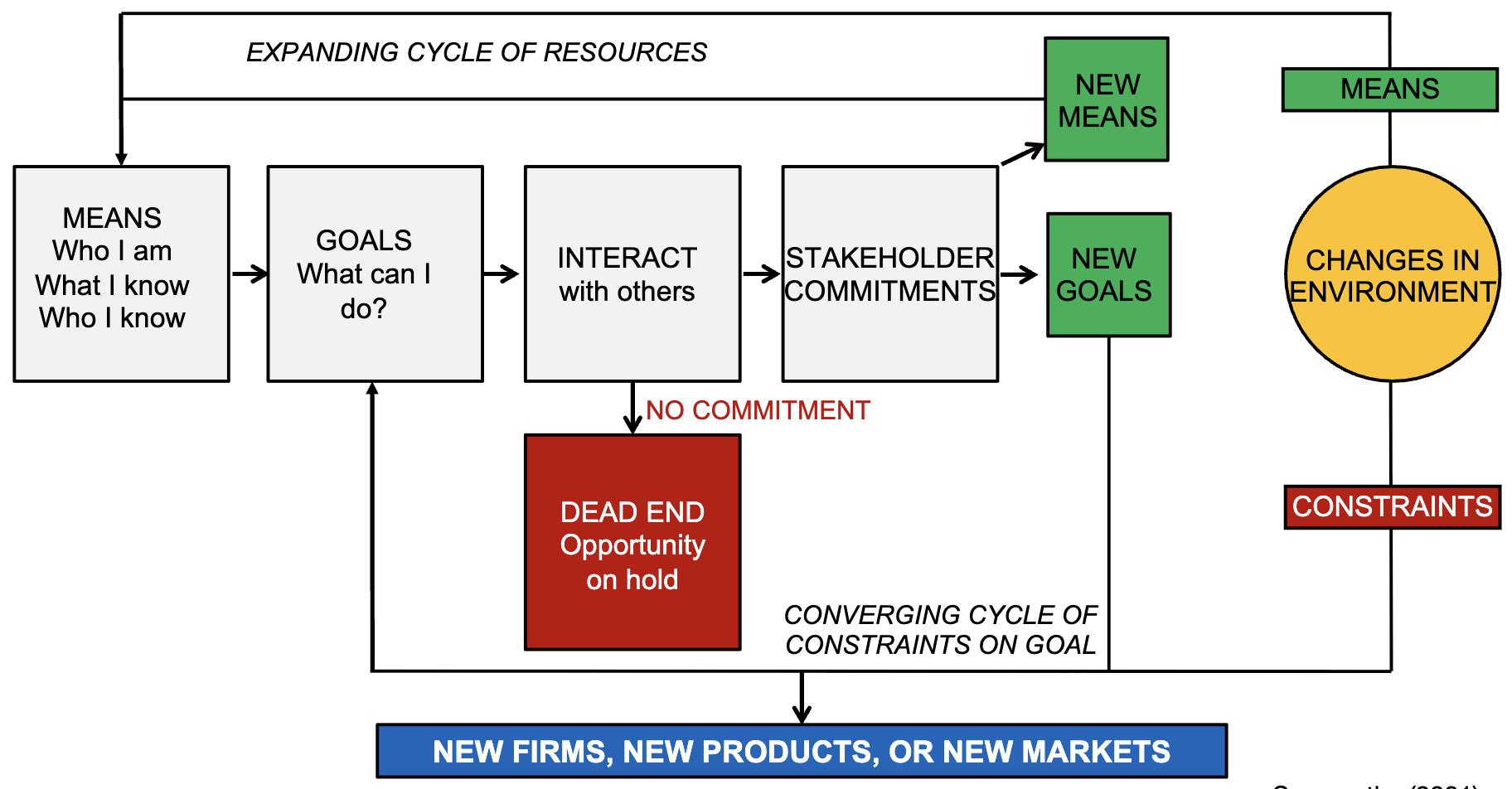
The process is an expanding cycle: Start with your means to set goals. Interact with others to get stakeholder commitments. These commitments generate new means and new goals, expanding your resources. If you get no commitment, the opportunity may be a dead end for now. (p. 27)
We also spoke about this in a CODE x Unknown workshop.
1. Bird-in-Hand: Start With Resources
Start with what you have: your resources, skills, and network.
- Your unique pool of resources can lead to unique opportunities. This includes: (p. 19)
- Who you are: Your traits, tastes, and abilities.
- What you know: Your education, training, and experience.
- Who you know: Your social and professional network.
- Examples: Steve Jobs’ interest in calligraphy influenced Mac’s typography; Ben Cohen’s lack of smell led to Ben & Jerry’s focus on texture; Whitney Wolfe Herd’s experience with online bullying inspired Bumble’s design. (p. 20)
An Interactive workshop on Nov. 11 is a game to practice this.
2. Affordable Loss: Risk What You Can Lose
Focus on what you can afford to lose, not on potential gains.
- Instead of a cost-benefit analysis, assess what you can afford to lose (money, time, reputation) and make decisions accordingly.
- This encourages taking manageable risks, as failure is a likely and productive part of learning in uncertain environments. (p. 22)
- Examples: Virgin Atlantic starting with a single leased second-hand plane; ChopValue using free recycled chopsticks as a primary resource.
3. Crazy Quilt: Form Partnerships
Build a future with customers, suppliers, and even competitors.
- In effectuation, partnerships are co-creational and evolve based on mutual interests, rather than being purely transactional. (p. 23)
- Partners who commit resources and share the vision help co-create the venture and collaboratively reduce uncertainty.
- Example: U-Haul collaborated with small gas stations as rental station partners; Mister Spex partnering with small opticians to expand reach and drive customers to physical stores.
Exactly what we’re doing with Jan Wegner and Florian Moser!
4. Leverage Contingencies: Embrace Surprises
Turn unexpected events into opportunities.
- While causation tries to predict and control the future, effectuation embraces uncertainty and adapts to change.
- Surprises, unexpected events, and even failures can provide new insights and lead to valuable opportunities. (p. 25)
- Examples: The invention of Post-it notes, Viagra, and the pivots of Instagram and Slack.