Resources
Market Entry
First-Mover vs. Late-Mover
This is the same as in Strategic Management: First-Mover vs. Late-Mover
| First-Mover | Late-Mover | |
|---|---|---|
| Examples | ebay, iPhone | Google, Pokémon Go |
| Advantages | Less competitive rivalry Secure suppliers and distributors Better position to satisfy customers Expertise through participation | Refining is easier than inventing Reduced R&D costs Organizational legitimacy Lower uncertainty |
| Disadvantages | Technological uncertainty Market uncertainty Value creation uncertainty | Loyalty to first-mover Resource access more expensive Catching up with first-movers |
Competitive Strategies explains additional factors like reasons for market entry and choosing a market.
Growing
Role of Founders
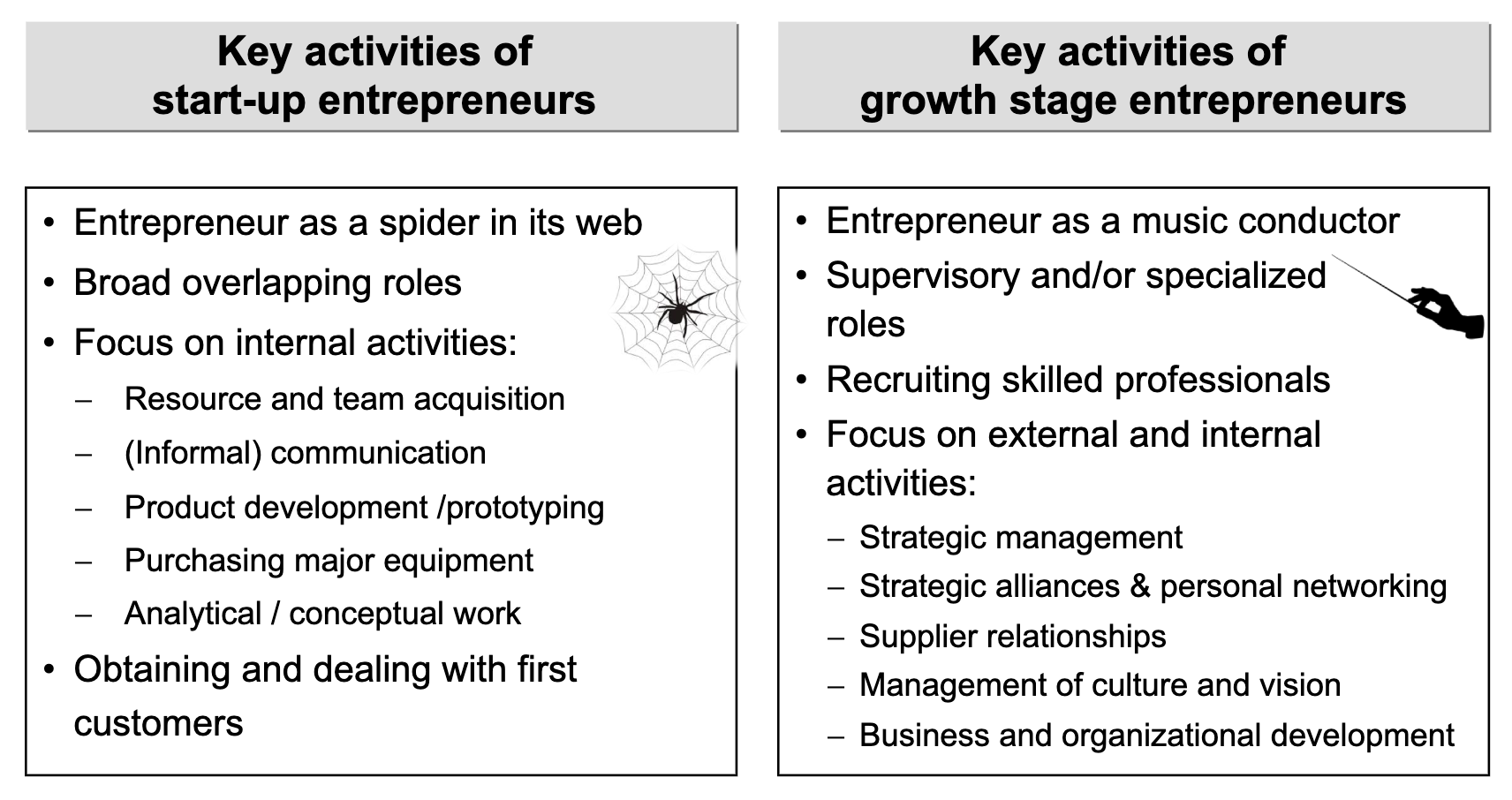
As the venture grows, the role of the entrepreneur changes:
- Before, founders worked on broad overlapping roles, focusing on internal activities (resource and team acquisition, product development, equipment, analytical and conceptual work), as well as obtaining first customers → Spider in its web
- After, they become more specialized or supervisory, recruiting skilled professionals and focusing on external and internal activities (strategy, networking, suppliers, culture and vision, organizational development) → Orchestra conductor, for example an Engineer-in-Chief
Growth Strategies
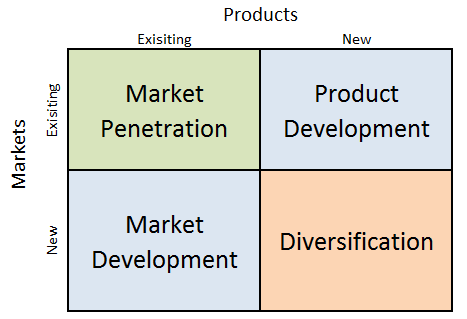
Based on the Ansoff Matrix, there are four main growth strategies:
Market Penetration Strategy
Existing products in existing markets.
Penetrate deeper into current markets: convince current customers to buy more, attract competitors’ customers, or convert non-users (take market share or expand market size). Does not involve anything new for the company.
Example: HEAD increasing its marketing budget to encourage customers to upgrade their skis more often.
Market Development Strategy
Existing products in new markets.
Identify new markets for current products: expand into new geographical areas, new customer segments, or new sales channels. This leverages existing products to sell to new customers.
New markets may be:
- Geographical: expanding to new regions or countries
- Demographic: targeting different age groups, income levels, or lifestyles
- Product use: finding new applications for existing products
Example: HEAD expanding to sell skis in Europe after success in the US market.
Product Development Strategy
New products in existing markets.
Develop new products for current markets: create new products or modify existing products to appeal to customers already purchasing the company’s products. This capitalizes on existing customer relationships and brand loyalty, offering the chance to employ existing distribution systems.
Example: HEAD introducing new ski models or related equipment (helmets, gloves, boots) to its existing customer base.
Diversification Strategy
New products in new markets.
Enter entirely new markets with new products: this is the riskiest strategy as it involves venturing into unfamiliar territory. It can be related (synergies with existing business) or unrelated (no synergies). This strategy can help spread risk across different markets and products.
Related diversification includes:
- Backward Integration: a step up/back in the value chain
- Forward Integration: a step down/forward in the value chain
- Horizontal Integration: expanding into a complementary value chain on the same level
Backward example: Designing and manufacturing of equipment used in ski production.
Forward example: Opening branded HEAD retail stores.
Horizontal example: Expanding into related sports equipment markets, such as tennis or swimming gear.
Growing vs. Scaling
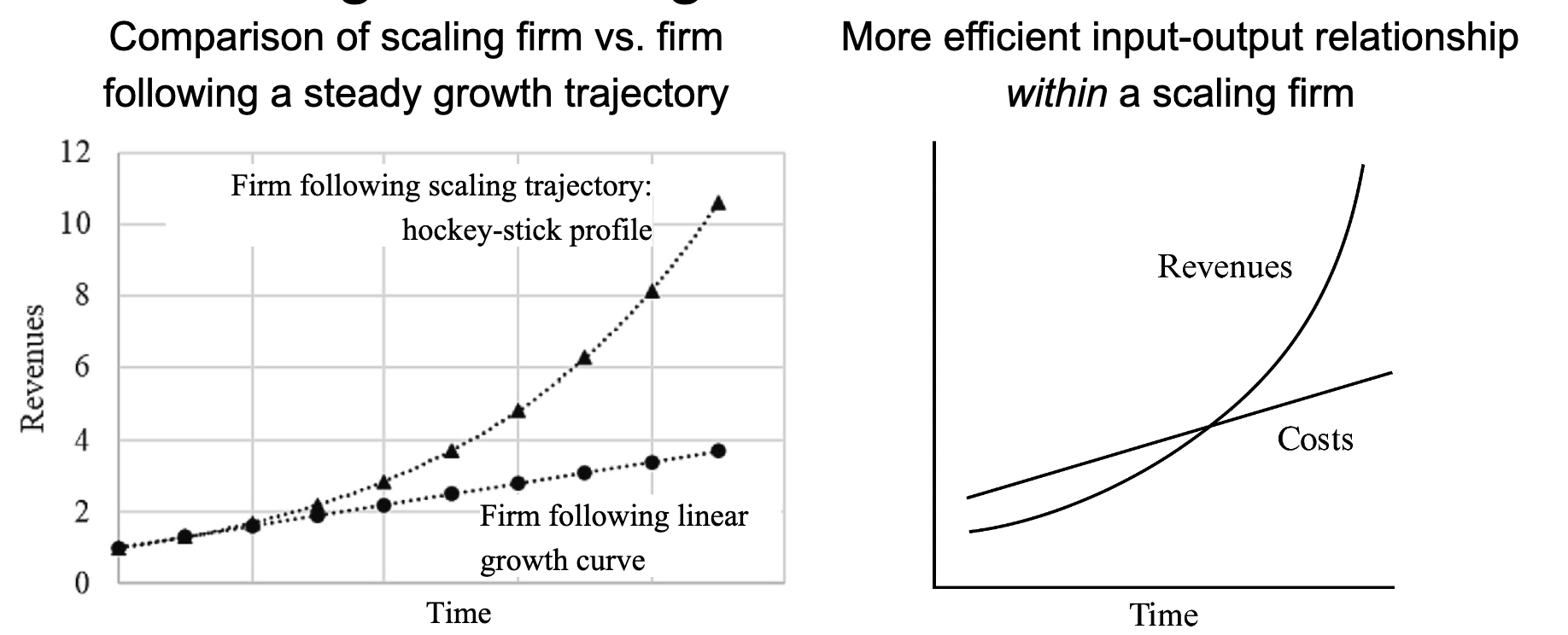
Scale-Ups have a growth strategy aimed at attaining economies of scale. Each additional customer served should cost less, through internal organization (standardization, automation).
-
Growing a business means increasing its revenue and market presence, often by adding more resources, employees, and infrastructure.
- Growth is linear and is proportional to the resources invested.
- With larger operations, businesses may face complexity issues.
- Examples: Opening new stores, hiring more staff.
-
Scaling a business means increasing revenue without a corresponding increase in costs. A scalable business model allows for rapid growth with minimal additional resources, often through automation, technology, or leveraging existing assets.
- Exponential scaling with linear or sub-linear cost increase.
- Scalable businesses can handle increased demand without a significant increase in operational complexity.
- Examples: Software companies, online platforms.
Growth Ambitions
Growth ambitions are diverse and may not only focus on monetary growth (opposing the teaching of Strategic and International Management). Successful start-ups are considered in two types:
Unicorns
Start-ups valued at **over 10+ billion.
Zebras
Start-ups that focus on both sustainable growth and profitability rather than rapid scaling. They prioritize steady growth with social impact, relationships, and long-term viability over quick market capture.
Zebras are seen as resilient and adaptive, often operating in sectors like social enterprises, sustainable products, and community-focused businesses.