Resources
- Slides
- Literature: Fredrickson 2005, Lämmermann 2025, Meyer 2019
Competitive Advantage
Characteristics:
- Company creates value for its customer:
- Realized price is above company’s costs
- -ratio is superior to competitors
- The area of this value is perceived by customers, important to them, and defendable against competitors
Competitive advantages are determined by an outside-in perspective: Customers decide what’s an advantage they’re willing to pay for. Too often companies follow an inside-out approach, assuming a technological feature is a competitive advantage.
Reasons for Loosing Advantages
- Competition: Innovation by competitors, such as new products, services, business models
- Changes in customer preferences: New trends, changing needs and preferences
- Technological progress: New technologies that make existing advantages obsolete
- Regulatory changes: New laws and regulations that affect the competitive landscape
- Investment delays: Failure to invest in maintaining or upgrading advantages, not taking risks
- Internal inefficiencies: Organizational issues that reduce the effectiveness of advantages
etc. this was not extensively covered in the lecture, only gathering from the audience.
Business Transformation
Over time, companies need to adapt their strategies to maintain competitive advantages. This can involve:
- Innovation: Developing new products, services, or business models
- Market expansion: Entering new markets or segments
- Operational improvements: Enhancing efficiency and effectiveness of operations
- Customer focus: Better understanding and serving customer needs
- Cultural change: Fostering a culture that supports adaptability and continuous improvement
among others.
While Netflix started as a DVD rental service, it transformed its business model to become a leading streaming service provider, adapting to changing customer preferences and technological advancements, now producing its own content and personalizing user experiences.
Companies that have not transformed and have struggled to maintain competitive advantages include Nokia (Apple), ABB (KUKA), Kodak (Canon), Oracle (Salesforce). Today, companies like Boeing/Airbus (SpaceX/Embaer), SEIKA (Apple Watch), DHL (Amazon Logistics), VW (BYD) are facing similar challenges.
Elements of Strategy
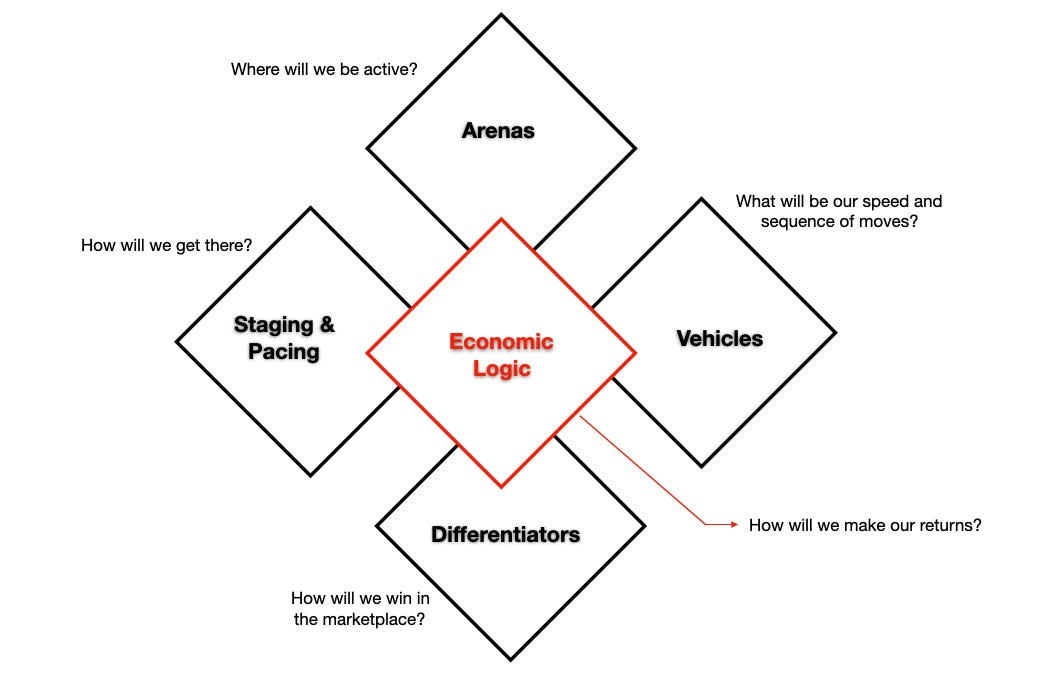
Hendrick & Fredrickson's Strategy Diamond
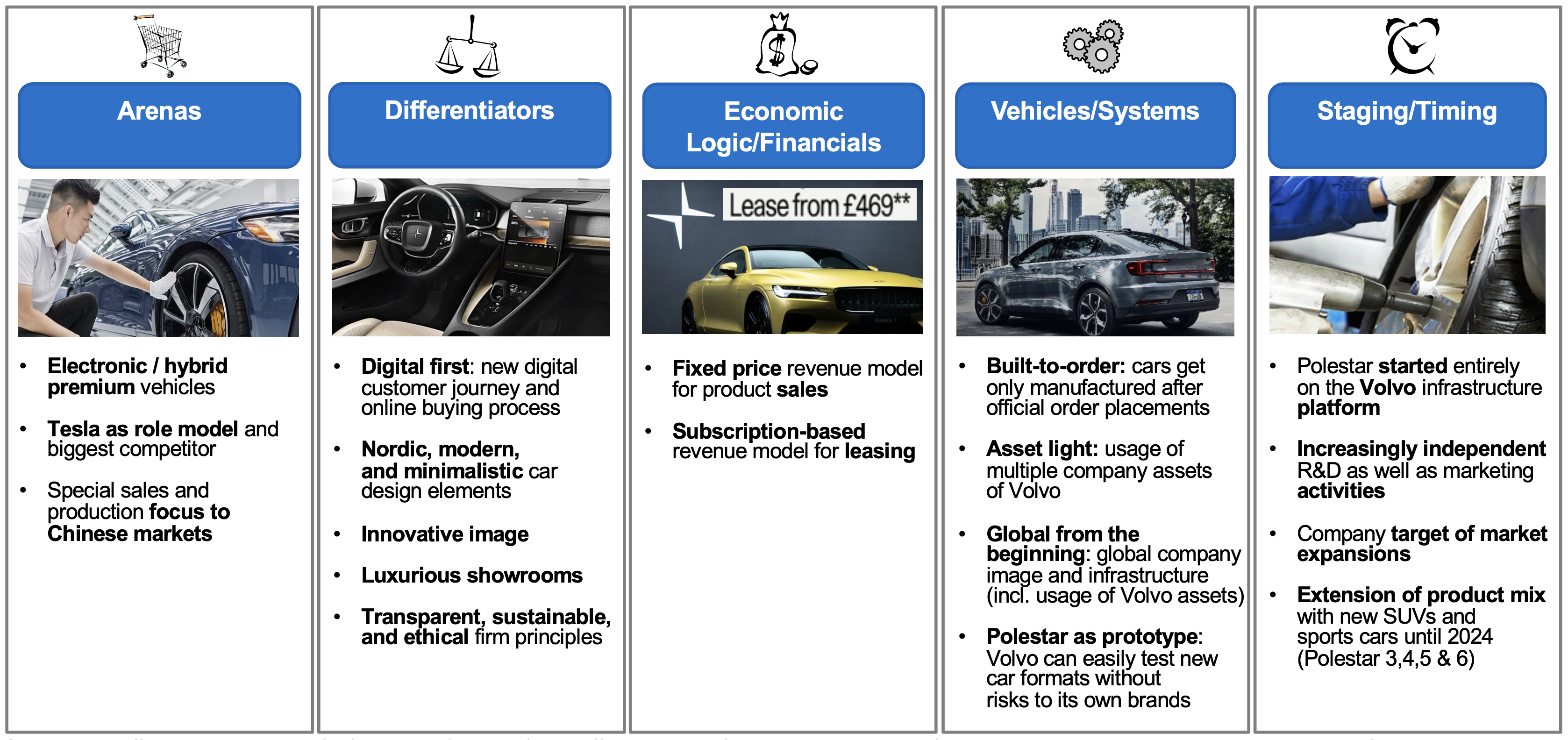
This framework breaks down strategy into 5 elements: Economic Logic (Financials), Arenas (Markets), Differentiators (Competitive Advantages), Vehicles (Value Chains), and Staging & Pacing (Timing). It helps in understanding and communicating a company’s strategy effectively.
Arenas / Markets
The arena is the first and most fundamental strategic choice. Companies may operate in multiple (overlapping) markets, bringing diverse competitors. These markets can be defined in qualitative or quantitative terms. The forces determining he attractiveness of an industry are Porter’s Five Forces.
Arenas are specific and distinct from vision or objectives: Instead of “automotive industry”, a company may choose to compete in “premium electric SUVs in Europe, controlling R&D but outsourcing sales”.
A precise market positioning is crucial to address customers and differentiate from competitors. BMW positions themselves on performance heritage and technological innovation; on the other hand, Infiniti struggled to find a clear position between Japanese heritage and tech luxury.
Differentiators / Competitive Advantages
Differentiators are the feature or capabilities that give a company a competitive edge, and may include price, quality, brand image, customization, customer service, technology, reliability, convenience, etc.
Differentiators must be hard to imitate and defendable against competitors, especially in fast-moving tech sectors. They must also be relevant to the local market and provide a sustainable advantage.
It’s key that these choices must be made deliberately, instead of trying to be the best at everything. The chosen differentiators should align with available resources and the targeted arena’s needs.
Generic Strategies
There are two main approaches to differentiate from competitors:
- Quality Leader: The differentiation approach focuses on superior quality, features, or performance. The price remains constant, but the value provided is higher. Example: Apple iPhone
- Price Leader: The cost leadership approach focuses on offering lower prices while maintaining a constant value proposition. This requires a cost advantage to sustain profitability. Example: IKEA
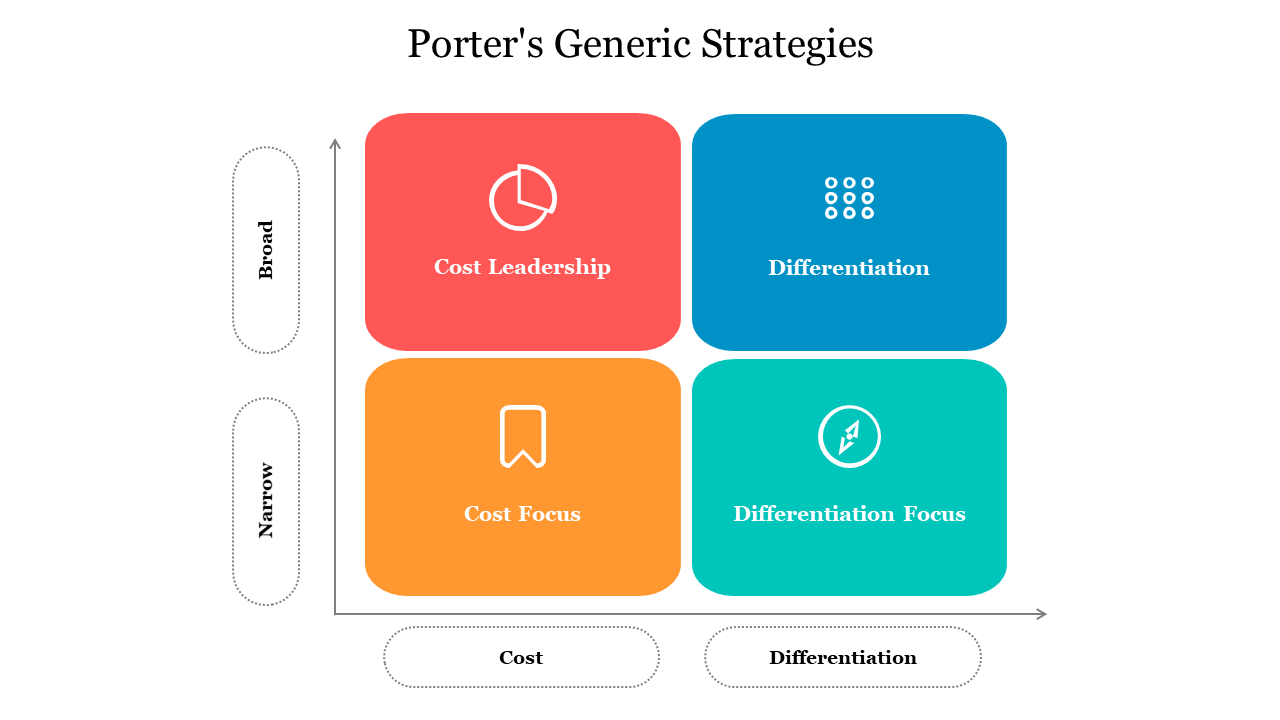
Porter’s Generic Strategies
Michael Porter proposed three generic strategies to achieve competitive advantage in an industry: cost leadership, differentiation, and focus. The focus strategies apply leadership in a narrow market segment rather than the whole industry.
Being stuck in the middle risks weak competitive position.
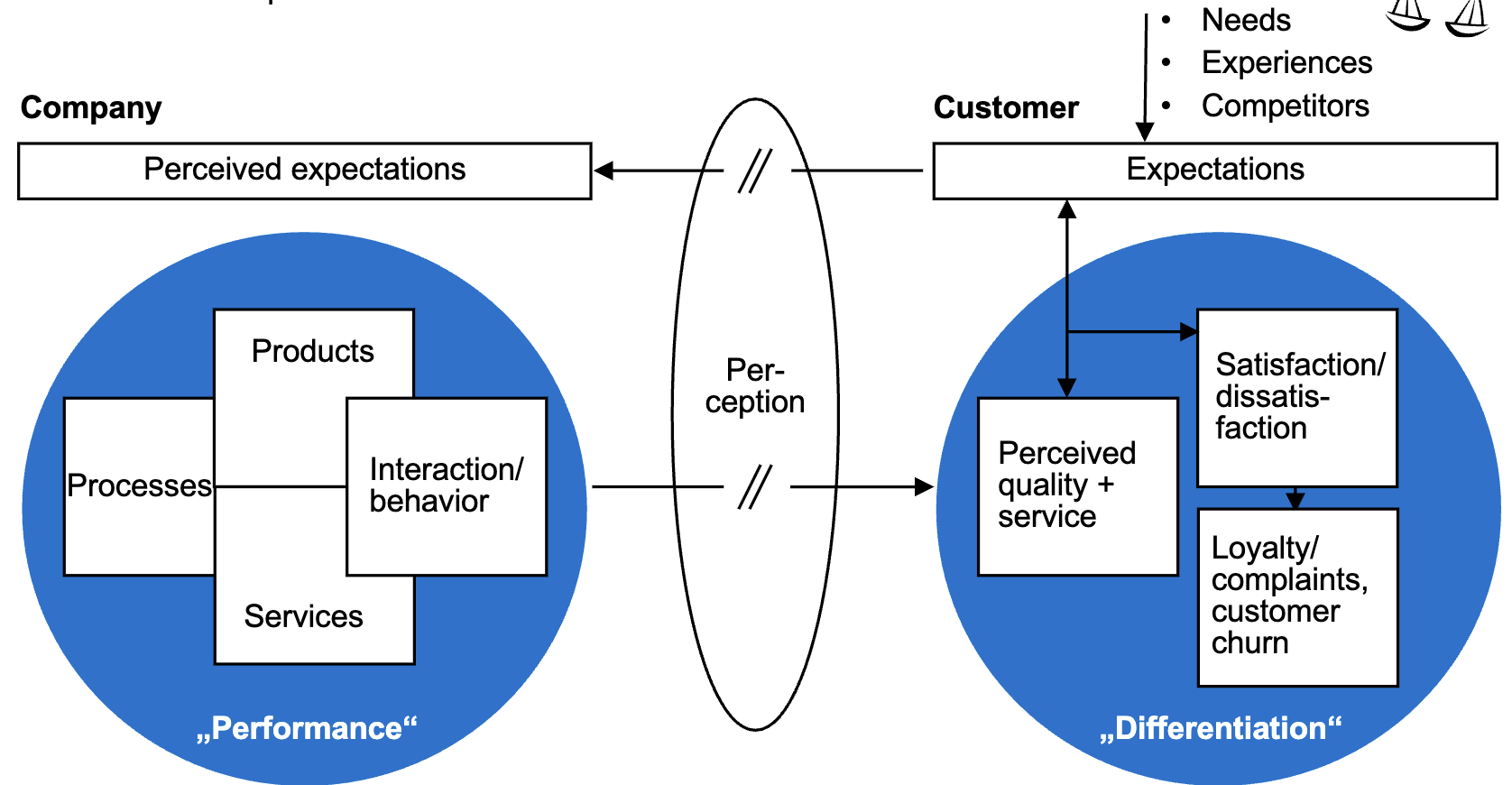
Evaluating Value
Contrary to price, value is subjective, and depends on customer perceptions. A high price may be justified by high value, while a low price may indicate low value.
Search, Experience & Trust Qualities
Differentiation and pricing power is affected by how easily customers can assess quality. Three types of goods affect this:
- Search qualities: Assessable before purchase (e.g. design, specs, price).
- Experience qualities: Only clear after use (e.g. taste, comfort, service experience).
- Trust / credence qualities: Hard to judge even after use; require expert trust or signals (e.g. medical, legal, consulting).
The more “experience/credence” the offering, the more important brand, reputation, guarantees, and third-party signals become as differentiators.
Vehicles / Value Chains
The value chain system enables a company to deliver its value proposition to customers. This determines which parts of the value chain the company controls, and which parts it pays for to outsource. It’s part of the companies conduct and includes production, marketing, distribution, and after-sales services.
Designing the business system means asking which value-creation functions to perform in-house or outsource, how to realize economies of scale, which sales-related support activities are necessary, and where individual functions can be carried out in especially innovative ways (p. 26).
Example: IKEA uses a self-assembly and self-service model with flat-pack furniture to reduce costs and offer lower prices.
Vertical Integration
Which stages of the value chain are owned: Which value creation activities are performed in-house vs. outsourced to partners or suppliers?
Examples include IKEA buying forests for wood supply, Apple designing its own chips, or Disney distributing movies through its own streaming service.
Sales Support
Which sales-related supporting functions are necessary or can provide additional value?
Sales support can be a differentiator as improved customer support or a vehicle if used to partner or integrate with service providers.
Examples include Red Bull sponsoring extreme sports events, SAP providing extensive customer support, or Tupperware hosting home parties for sales.The lecture slides also refer to economies of scale (financials) and differentiation as part of this step; I don’t think this makes sense.
Financials
Companies need to design their revenue and margin models to ensure profitability and sustainability. The economic logic must be defensible, not easily eroded by competitors.
Common forms of economic logic include premium pricing (quality leadership), cost leadership (low costs through scale, experience, unique processes), efficiency (leveraging scale, network effects, operational excellence), and bundling/integration (saving customers time, money, complexity).
Economies of Scale
How can sub-proportional cost development be achieved?
Examples include Amazon building large fulfillment centers, or car manufacturers standardizing parts across models.
Revenue Models
Different revenue models include:
- Pay-Per-Use: Customers pay based on usage (e.g., utilities, cloud services).
- Subscription: Customers pay a recurring fee for access (e.g., Netflix, gym memberships).
- Multi-Sided Markets: Connecting two distinct customer groups (e.g., credit cards, online marketplaces). Sometimes user pay nothing (but data), but the other side pays (e.g., social media platforms).
- Cross-Subsidy of Complementary Goods: One product is sold at a low price (or given away) to drive sales of a complementary product (e.g., printers and ink cartridges, coffee pod machines). Requires lock-in effects and incompatibility with competitors.
Margin Models
Companies can follow low or high margin strategies:
- Low Margin, High Volume: Selling large quantities at low profit margins. This means low fixed costs with higher variable costs, resulting in a smaller angle between total cost and revenue. Key industry examples like retail (Lidl) or fast food (McDonald’s).
- High Margin, Low Volume: Selling fewer units at high profit margins. Here, fixed costs are higher, but variable cost is relatively lower. According to Thomas, the highest margin industry is software (e.g., Microsoft, Adobe), followed by pharmaceuticals (e.g., Pfizer, Roche).
Variable and Fixed Costs: Marginal Cost, Contribution Margin, Break-Even Point
Understanding cost structures is crucial for pricing and profitability.
- Fixed Costs: Costs that do not change with production volume (e.g., rent, salaries).
- Variable Costs: Costs that vary directly with production volume (e.g., raw materials, direct labor).
- Marginal Cost: The additional cost of producing one more unit.
- Contribution Margin: The difference between sales price per unit and variable cost per unit. It contributes to covering fixed costs and generating profit.
- Break-Even Point: The sales volume at which total revenue equals total costs, resulting in zero profit:
Investment Period
The time frame over which a company expects to recover its initial investment and start generating profits. This period can vary significantly depending on the industry, business model, and market conditions.
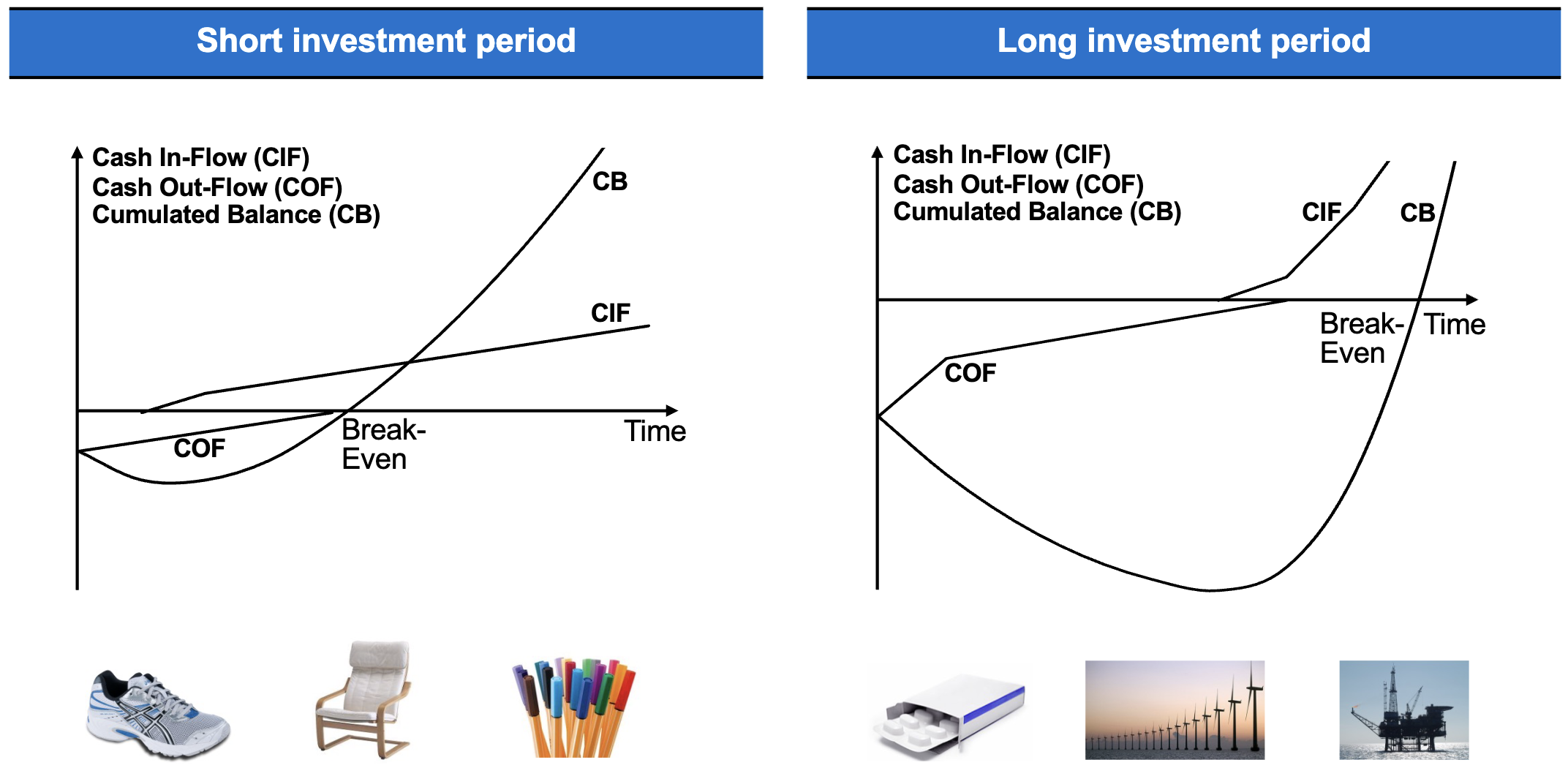
- Short Investment Period: Industries like fashion or furniture have quicker turnover and less negative cumulated balance. They pick up cash inflow quickly after initial investment.
- Long Investment Period: Industries like pharmaceuticals or energy require significant upfront investment and have longer payback periods. They may experience prolonged negative cash flow before becoming profitable.
Influence of Exchange Rates
Operating across currency borders introduces exchange rate risks that can impact financial performance. Strategies to mitigate these risks include:
- Hedging: Using financial instruments to lock in exchange rates.
- Diversification: Spreading operations across multiple currencies to reduce exposure.
- Pricing Strategies: Adjusting prices to account for currency fluctuations.
Timing and Staging
Staging aspects determine how quickly and in what order a company enters markets or launches products. It is not just about being first, but about aligning with resources, market readiness, and objectives.
Timing matters when the sequence and speed of strategic moves influence the final outcome, and matters less when actions are largely independent and easily reversible (p. 34).
- Speed: How quickly a firm expands or introduces new products
- Sequence: Which initiatives are prioritized and in what order
- Resource Allocation: Staging decisions are influenced by resource constraints, urgency, and the need to achieve credibility or early wins
In the age of AI, timing becomes even more critical, where firms must proactively monitor for technological changes and market shifts, and ability to change quickly is a competitive advantage.
First-Mover vs. Late-Mover
Timing is central to entry strategies, determining whether a company should be a first-mover or a late-mover. Market-seekers often pursue first-mover advantages, however, both approaches have risks and rewards. This is consistent with First-Mover vs. Late-Mover.
First Mover Advantages
- Brand Recognition & Customer Loyalty: Early entrants can establish their brands and build customer loyalty before competitors arrive.
- Access to Resources: They may secure the best locations, suppliers, or partners.
- Setting Standards: First movers can influence industry standards and customer expectations.
- Learning Curve: They can gain experience and adapt to local markets faster than later entrants.
Late Mover Advantages
- Free-Rider Effects: Late movers can learn from the mistakes and investments of pioneers, especially in educating customers or overcoming regulatory barriers.
- Reduced Uncertainty: Waiting can provide more information about market conditions and technology.
- Flexibility: Late movers may leapfrog by adapting newer, better technologies or business models.
- Overcoming Incumbent Inertia: First movers may be locked into outdated assets or practices, giving agile latecomers an edge.
Market Entry Strategies
Entering a market disrupts the existing equilibrium among incumbents, customers, and suppliers.
Reasons for Market Entry
Cross-Investment
A foreign market entry can be triggered a foreign competitor investing in the home market. This creates pressure to respond and defend market position, and thus entering a foreign market.
Example: Instagram launching Reels globally to compete with TikTok after its success in the US.
Follow-The-Leader
Followers enter foreign markets to follow industry leaders, maintaining competitive parity and avoiding disadvantages.
Example: Volvo moving local production to China to stay competitive with other European carmakers.
Market Entry by Business Model
If a business model requires global scale or network effects, firms may enter foreign markets to achieve these advantages. This can be the case when fix costs are very high.
Example: Pharmaceutical companies entering multiple countries to recoup R&D investments.
Market Entry to Leveraging Core Competencies
Firms may enter foreign markets to exploit their unique capabilities or resources that provide a competitive advantage, and expand their reach.
Example: Amazon initially expanding to additional product categories to leverage its experience in selling books, at different times in different geographical markets.
Choosing an Arena
When choosing a market to enter, potential is weighed against entry barriers and risks. The choice of market is shaped by strategic goals:
- Resource-seeking: Where are the needed resources?
- Market-seeking: Which markets have the most attractive demand?
- Efficiency-seeking: Where can operations be most efficient?
- Capability-seeking: Where are the best technologies or knowledge clusters?
When entering a new market, the company has to turn from outsider to insider: gaining market-specific knowledge, and exploring the arena with or without a partner.
Localization and Integration
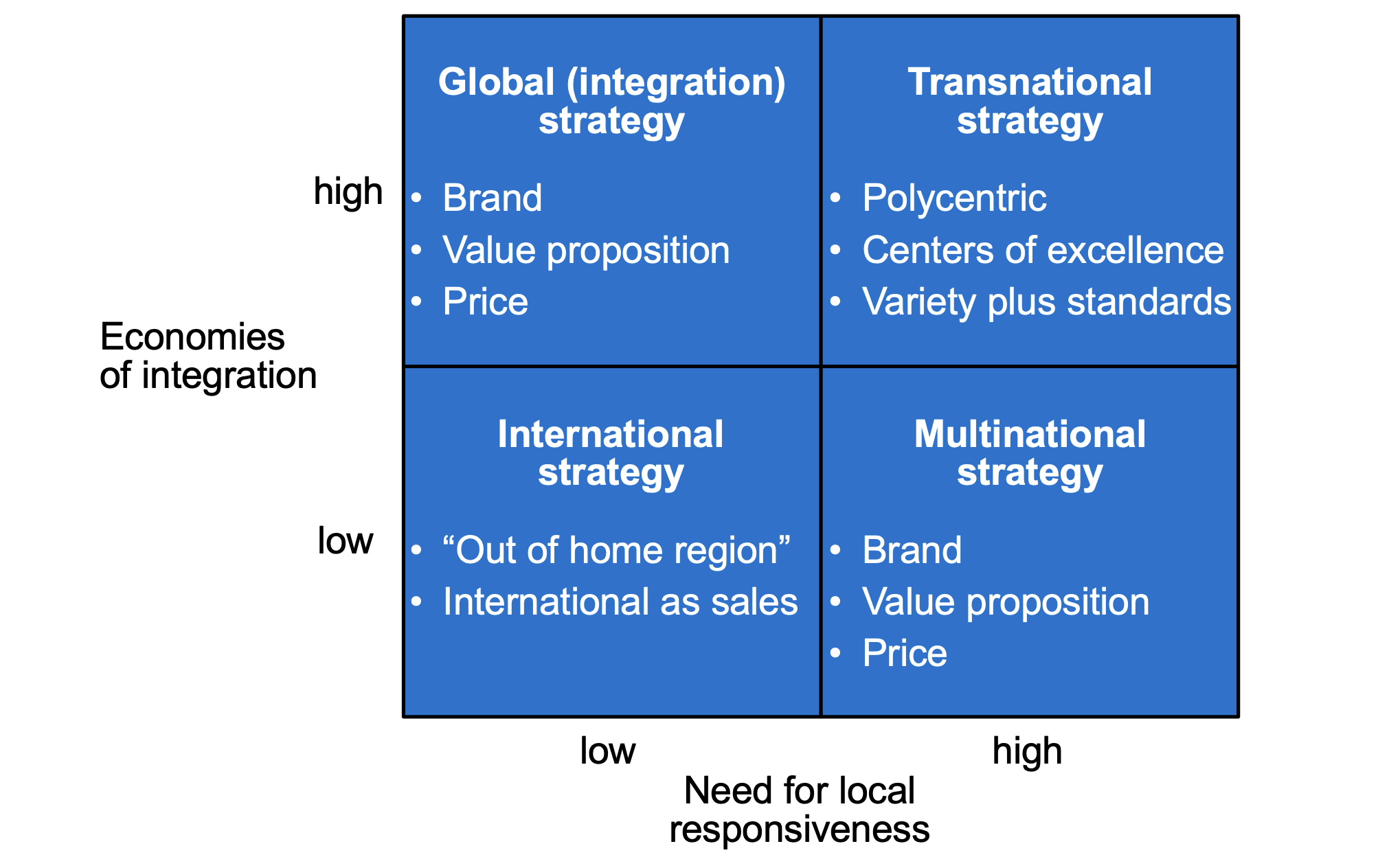
Different markets require different amount of adaptation and allow for different levels of integration into global operations. Depending on the market, 4 strategies can be followed:
- Global Strategy: Standardized products and centralized operations for efficiency and consistency. This works for commodities or universal products; high integration, low localization. Brand, value proposition, and operations are the same worldwide.
- Transnational Strategy: Balancing global efficiency with local responsiveness. Some adaptation of products and operations to local markets; high integration, high localization. Core brand and value proposition are consistent, but marketing and certain features are adapted in a polycentric approach.
- International Strategy: Centralized operations with minimal local adaptation. Products and operations are mostly standardized; low integration, low localization. The same products and processes are used globally with little change.
- Multinational Strategy: Significant local adaptation with decentralized operations. Products and operations are tailored to each market; low integration, high localization. Each market has its own brand, value proposition, and operations.
Bartlett & Ghoshal: Integration–Responsiveness Matrix
Firms face two key pressures: global integration (efficiency, standardization) and local responsiveness (adaptation to local needs). The balance between these pressures determines the optimal archetypal international strategy (see the CAGE framework).
Ghemawat’s AAA Triangle
Pankaj Ghemawat proposed three generic approaches to create global value by addressing cross-country differences and similarities.
- Adaptation: Adjust offerings and activities to local differences to increase revenues/market share (high local responsiveness).
- Aggregation: Exploit similarities across countries via regional/global scale, shared platforms, and standardization (high integration).
- Arbitrage: Exploit cross-country differences (e.g. labor costs, taxes, resources, capital costs; influences cost structure and entry mode choices).
A clear global strategy typically emphasizes one “A”, sometimes two, while being aware of trade-offs between them.
Market Entry Mode
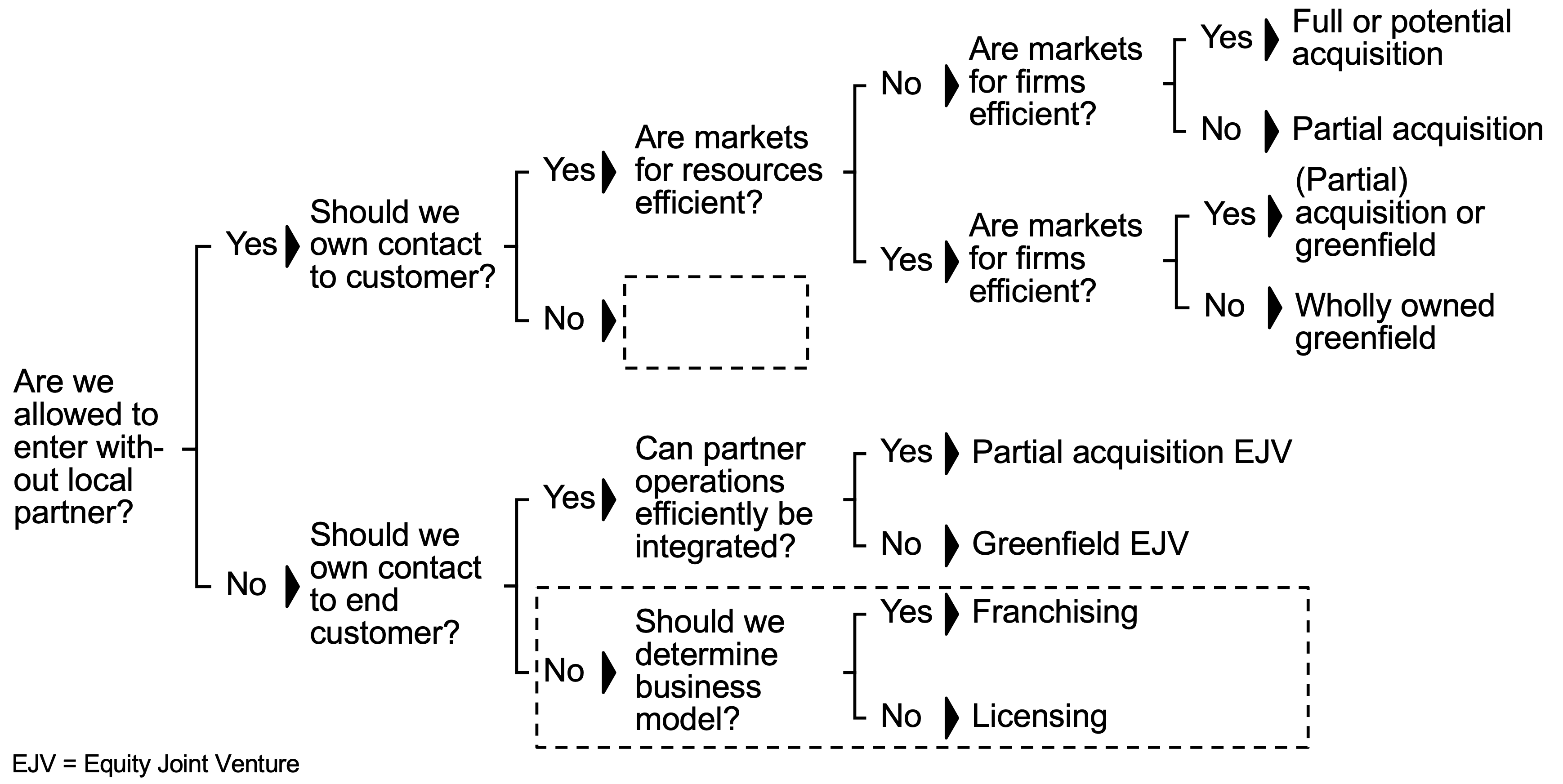
There are various modes to enter a foreign market, each with different levels of commitment, control, risk, and resource requirements, outlined in the diagram below.
Equity vs. Non-Equity Modes
- Equity modes: Joint ventures, wholly owned subsidiaries (WOS), acquisitions. Higher commitment, control, and risk, preferred for transferring proprietary assets or integrating deeply.
- Non-equity modes: Exporting, licensing, franchising, contractual agreements. Lower commitment and risk, suitable for smaller firms or initial market tests.
Greenfield vs. Acquisition
- Greenfield: Build from scratch; allows full control and alignment with parent company culture, but slower and riskier.
- Acquisition: Buy an existing firm; faster, provides local resources and networks, but integration can be challenging.
Dunning’s OLI Paradigm (Eclectic Framework)
Explains when firms choose FDI (foreign direct investment) / equity modes (e.g. JV, WOS, acquisition) instead of exporting or licensing. Three conditions should hold simultaneously:
- Ownership advantages (O): Firm-specific assets (brand, technology, management capabilities, processes) that can generate superior returns abroad.
- Location advantages (L): Host-country conditions that make producing/operating there attractive (costs, resources, market size, clusters).
- Internalization advantages (I): Benefits of keeping activities inside the firm (control, protection of know-how, lower transaction/coordination costs) instead of using arm’s-length contracts.
If O, L, or I is weak, non-equity entry modes (exporting, licensing, franchising) are more likely than FDI.
Questions
Exercise 1
Question:
The U.S. American company Xtra Inc. only sells its products in the United States. It produces the products in both, the U.S and Mexico. In 2024, Xtra Inc. has revenues of USD 4600, with cost of USD 1800 for the US production and cost of MXN 50000 (Mexican Pesos) for the Mexican production. The exchange rate for 2024 is MXN 25 per USD 1. In 2025 the exchange rate is MXN 20 per USD 1, while the revenue and cost figures remain constant in their local currency.
Which of the following statements is true?
a) The company’s profit in 2025 is 500 USD higher than in 2024.
b) The company’s profit in 2025 is 500 USD lower than in 2024.
c) The company’s profit in 2025 is 200 USD higher than in 2024.
d) The company’s profit in 2025 is 200 USD lower than in 2024.
e) The company’s profit in 2025 is 200 USD.
Correct answer: b
Explanation:
In 2024, the Mexican cost in USD is , so profit is USD.
In 2025, the Mexican cost in USD is , so profit is USD.
The profit in 2025 is USD lower than in 2024, thus option (b) is correct.