What is a company?
Resources
- Slides
- Literature: Drucker 1954, Peng, Meyer 2019]]
Six Dimensions of Management
What Is Management?
Management is a multifaceted activity that involves:
- Managing a business: The entire process from perceiving a demand to delivering a solution (value creation) and facilitating the final exchange and consumption. (p. 5)
- Managing an organization: Coordinating internal relationships and functions. (p. 6)
- Managing flows: Organizing the internal and external flows of goods, information, and currency. (p. 7)
- Managing stakeholder relationships: Balancing the wants and contributions of various external stakeholders like shareholders, suppliers, customers, and the public. (p. 8)
- Managing people: This includes the coordination and motivation of non-managers, other managers, and oneself. (p. 10)
The Three Core Jobs of Management
Building on Drucker, management can be viewed as performing three tightly connected jobs:
-
Managing a business (Drucker p. 8)
- Puts economic performance first, supplying goods and services customers want at a price they are willing to pay and maintaining the wealth‑producing capacity of resources.
- Goes beyond passive adaptation: managers do not only react to the environment (like a “trader” or “investor”), but actively try to shape markets and make desirable futures possible.
- Implies management by objectives: defining what results are desirable and aligning actions accordingly. (Drucker p. 12)
-
Managing managers (Drucker p. 12)
- Turns human and material resources into a productive enterprise that is more than the sum of its parts (“a genuine whole”).
- Focuses on human resources as the only resource that can grow and develop; management must organize, develop, and integrate managers so their capabilities can scale the enterprise.
- Recognizes that managers are among the costliest resources and that using this investment well is a central managerial responsibility.
-
Managing workers and work (Drucker p. 14)
- Designs work so that it is suitable for human beings (physically and psychologically) and organizes people so they can work productively and effectively.
- Treats people both as a resource (with capabilities and limitations) and as human beings (with personality, citizenship, choice), requiring motivation, participation, incentives, leadership, and a meaningful function.
The three jobs are integrated: every important management decision simultaneously affects the business, managers, and workers/work, in both present and future. (p. 16)
From Demand to Consumption
The process of managing a business starts with a customer need and ends with its fulfillment. (p. 5)
- Demand: Requires a motive and, crucially, a willingness to pay.
- Perception: Managers perceive this demand.
- Resources: They utilize available resources to develop a “solution”.
- Value Creation: This solution is designed to create value for the customer.
- Exchange: The resulting product or service is exchanged, typically for money, but also for non-monetary value like data or attention.
- Consumption: The customer uses the product or service.
Why Does Management Need Objectives?
“If you don’t have a goal, you don’t know where to go.” (p. 12)
Setting clear goals is vital for defining a path forward. Strategy has two levels: (p. 13)
- Intentional Level: The underlying intentions or goals an actor wants to achieve.
- Instrumental Level: The instruments (i.e., the strategy itself) used to pursue those intentions.
flowchart TD

subgraph Intentional Process
direction LR

A[Change]

B((Uncertainty))

C[Success]

A-->B

B-->C

end
Types of Objectives
Objectives can be categorized along several dimensions: (p. 14)
- Level of Achievement: Maximizing/Optimizing or Satisfying.
- Time Horizon: Long-term (e.g., 3–5 years) or Short-term.
- Monetarity: Financial or Non-financial.
- Concreteness: Concrete/Quantitative or Abstract/Qualitative.
How Does Management Work?
Management is the process of making and implementing decisions.
The Management Process
This process can be broken down into three main phases (p. 17), which are explained in Strategy Making.
Alternatives to Conscious Decision-Making
Not all management actions are the result of a conscious, structured process. Alternatives include: (p. 18)
- Being Inactive: Choosing not to make a decision or take action.
- Routines: Relying on established, automatic procedures.
- Gambling: Making a bet for luck without a rational evaluation.
- Gut Feeling (Nonconsciousness): Relying on intuition for a decision.
Who Is a Manager?
A manager is a person with a mandate to manage. This role is distinct from ownership and supervision. (p. 21)
- Owner-Manager: Owns the company and has a mandate to manage (Example: Mark Zuckerberg).
- Non-Owner Manager: Does not own the company but is employed to manage it (Example: Tim Cook).
- Owner without management mandate: Owns shares but is not involved in day-to-day decisions (Example: A typical shareholder).
- Supervisory Board Member: Has a mandate to supervise management, can be an owner or non-owner.
When Is Management?
Time is a critical dimension that influences the entire management process and its outcomes. (p. 23)
- Management actions are taken at one point in time () and their results materialize at a future point (). (p. 24)
- Example: Investing in R&D incurs costs today but can lead to significant positive returns in the future. Avoiding R&D has no immediate cost but may lead to a loss of market share later.
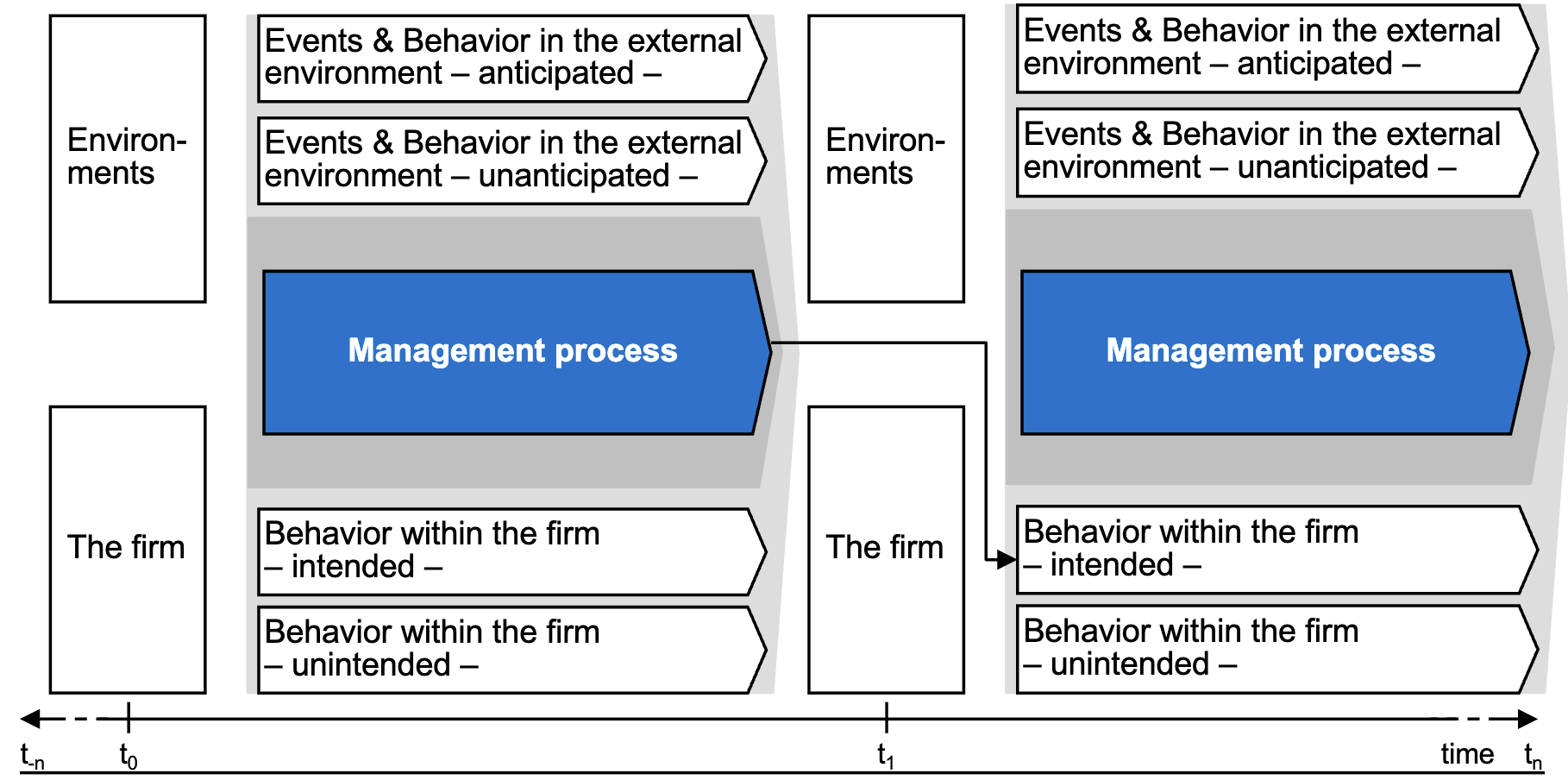
Additional aspects of the time dimension (Drucker, p. 15):
- Management must live in present and future simultaneously: ensure current profitability while building future capabilities (research, investments, people).
- One-sided focus on either present or future creates illusory performance (e.g., short-term profits by consuming capital and leaving a “burned-out” company behind).
Factors of Change
A firm is continuously changed by a combination of external and internal factors over time: (p. 25)
- External Environment:
- Anticipated Events: Foreseeable changes like new regulations.
- Unanticipated Events: Sudden, unexpected events like a financial crisis or pandemic.
- Within the Firm:
- Intended Behavior: Actions and results aligned with management’s plans.
- Unintended Behavior: Unforeseen actions and outcomes within the organization.
- Management Process: The decisions made by management that steer the firm.
This has to be considered in strategy making.
Where Is Management?
Management operates in multiple local and global spheres. The “where” dimension involves the location of: (p. 28)
- Value Chain Activities: Primary (e.g., production, sales) and secondary (e.g., HR, IT) functions can be distributed globally.
- Responsibilities: Objectives and strategies may be set for different geographical locations.
- Stakeholders: Customers, employees, suppliers, and shareholders are often located in different countries.
This global setup is influenced by forces of globalization (e.g., exchange of goods, capital, information) and antiglobalization (e.g., trade barriers, political tensions), which change the similarities and differences between markets (cultural, administrative, geographic, economic).
CAGE Distance Framework
The CAGE framework is a tool to analyze differences between home and host markets that matter for “where” management decisions:
- Cultural distance: Differences in language, values, norms, and consumer preferences.
- Administrative distance: Differences in laws, regulations, political systems, and memberships (e.g., EU, WTO). (Peng p. 6)
- Geographic distance: Physical distance, time zones, logistics, infrastructure.
- Economic distance: Differences in income levels, cost structures, and market sophistication.
Managers use CAGE to judge how “far” a foreign market really is, beyond pure kilometers, and to choose appropriate entry modes and configurations of the value chain. (p. 28)
International Business Basics
International business focuses on how firms engage across borders and why this matters:
- International Business (IB): Firms engaging in cross-border economic activities; the activity of doing business abroad (e.g., exporting, investing). (p. 6)
- Multinational Enterprise (MNE): A firm that undertakes foreign direct investment (FDI) and directly manages value‑added activities in more than one country (e.g., adidas, VW). (p. 6)
- Foreign Direct Investment (FDI): Investment to control and manage value‑adding activities abroad (e.g., a plant or subsidiary), not just arm’s‑length exporting. (p. 6)
Understanding international business is particularly relevant because:
- In the EU single market, the line between domestic and international is blurred; many firms treat Europe as their extended home market. Even SMEs often have international suppliers, customers, or owners.
- Emerging economies (e.g., China, India, Brazil) are increasingly important as production locations, growth markets, and sources of innovation. (p. 3)
Views of Success
Peng offers two complementary perspectives on what makes firms succeed or fail in different countries and over time: (p. 10)
Institution-Based View: Rules of the Game
- Firms are shaped by formal rules (laws, regulations, property rights, trade and investment rules) and informal rules (culture, norms, values). (p. 11)
- These rules enable or constrain strategy (e.g., equal treatment vs. protectionism for foreign firms).
- Foreign firms face a liability of outsidership: they lack local familiarity and networks, especially when CAGE distance is high. (p. 11)
Resource-Based View: Firm-Specific Advantages
- Focuses on internal strengths: resources and capabilities (technology, brand, routines, culture, systems). (p. 11)
- Some resources are VRIN, creating sustained advantage.
- In international business, foreign firms must have enough firm-specific advantages to offset outsidership and CAGE distance; management must build, protect, and adapt these across countries.
Together, the institution-based view (rules) and the resource-based view (firm strengths) give a more complete explanation of why some firms succeed and others fail in different countries and over time.