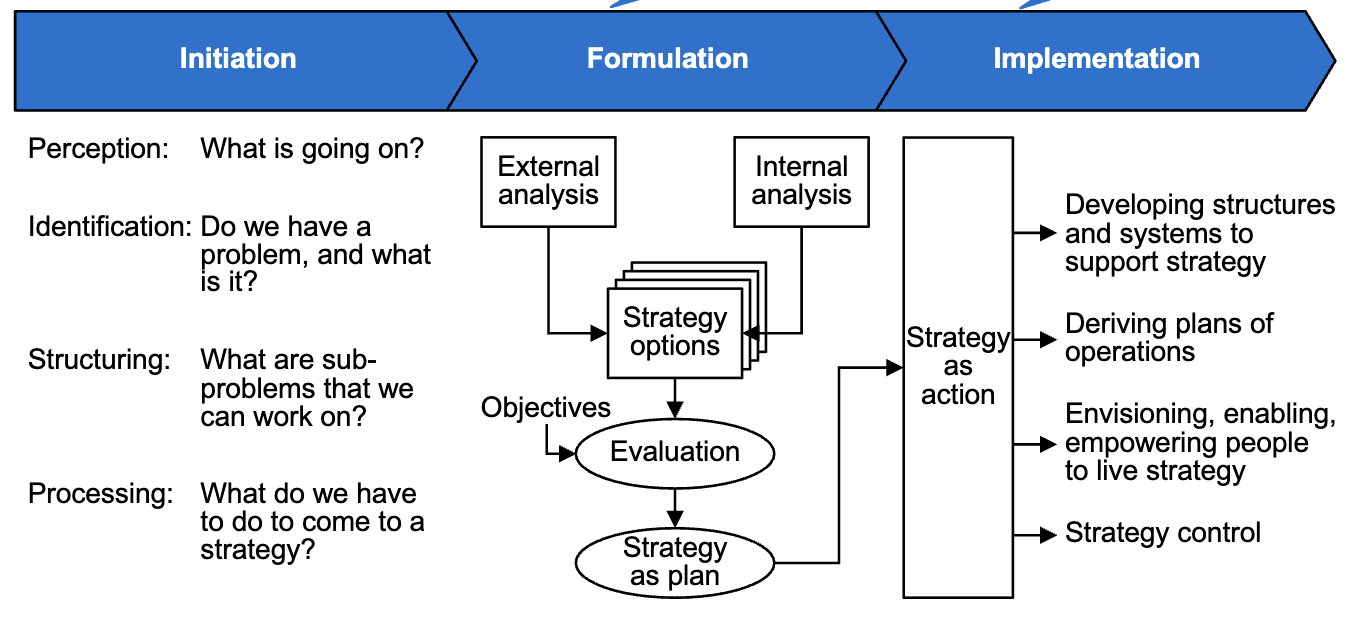
Management focusses on influencing the change process in organizations to achieve strategic goals (Foundations of Management). The change process consists of three main phases:
- Initiation: Analysis — Strategic Decision Making and Performance
- Problem Identification: Perceiving a problem and analyzing its external and internal causes.
- Perception: What is happening in the environment?
- Identification: What does it mean for the company?
- Managers perceive problems when set objectives aren’t met
- Information Structuring: Processing and structuring the gathered information.
- Structuring: Break down into subproblems
- Processing: What is needed to come to a strategy?
- Problem Identification: Perceiving a problem and analyzing its external and internal causes.
- Formulation: Strategy as plan — Strategy Analysis and Chapter 5
- Objective Setting: Defining objectives based on their type, level, and time horizon.
- Analysis: Conducting internal and external analysis to understand resources, costs, and the environment.
- External analysis and internal analysis to assess the strategic position of the company
- Searching for Alternatives: Developing standalone options or comprehensive programs.
- Evaluation & Decision: Assessing alternatives based on utility, value, and risk, leading to a final selection.
- Implementation: Strategy as action — Chapter 6
- Adaption: Adjusting organizational structures, processes, systems, and culture.
- Developing structures and processes
- Deriving plans of operations
- Envisioning, enabling, empowering people to live strategy
- Control: Comparing results against objectives (pre-post comparisons) and initiating new processes if needed.
- Adaption: Adjusting organizational structures, processes, systems, and culture.
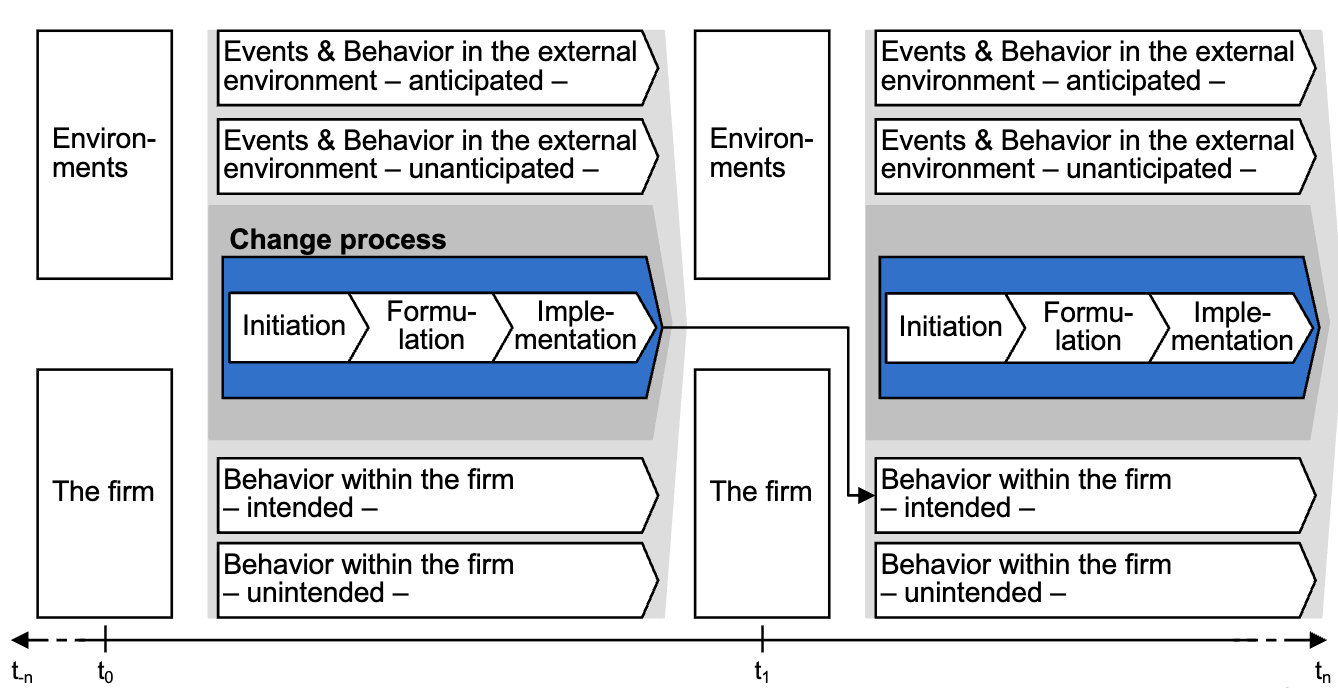
Anticipated & Unanticipated Change
Change factors, both within the firm and external events can be anticipated (predictable) or unanticipated (unpredictable). The management process must account for both types.
AFI Strategy process
The overall strategy process can be structured as Analysis – Formulation – Implementation (AFI): external and internal analysis → strategic choices → putting strategy into action and building supporting structures.
A good strategy combines three elements: a clear diagnosis of the competitive challenge, a guiding policy to address it, and a coherent set of actions that consistently implement this policy.
Rothaermel, F.T., 2024, Chapter 1.pdf
Deliberate vs Emergent Strategy (Mintzberg)
- Deliberate strategy: Intended, planned course of action that is consciously formulated (e.g. AFI strategy process) and then realized as intended.
- Emergent strategy: A pattern in actions that arises over time without being fully planned in advance (e.g. incremental adjustments, learning from experiments and logical incrementalism).
In reality, most firms combine both: a deliberate guiding policy with room for emergent adaptation to unexpected change.