Resources
Resource Mobilization
Resource mobilization is the process of identifying, acquiring, and utilizing resources to achieve organizational goals. In entrepreneurship, effective resource management is crucial for venture success. (p. 5)
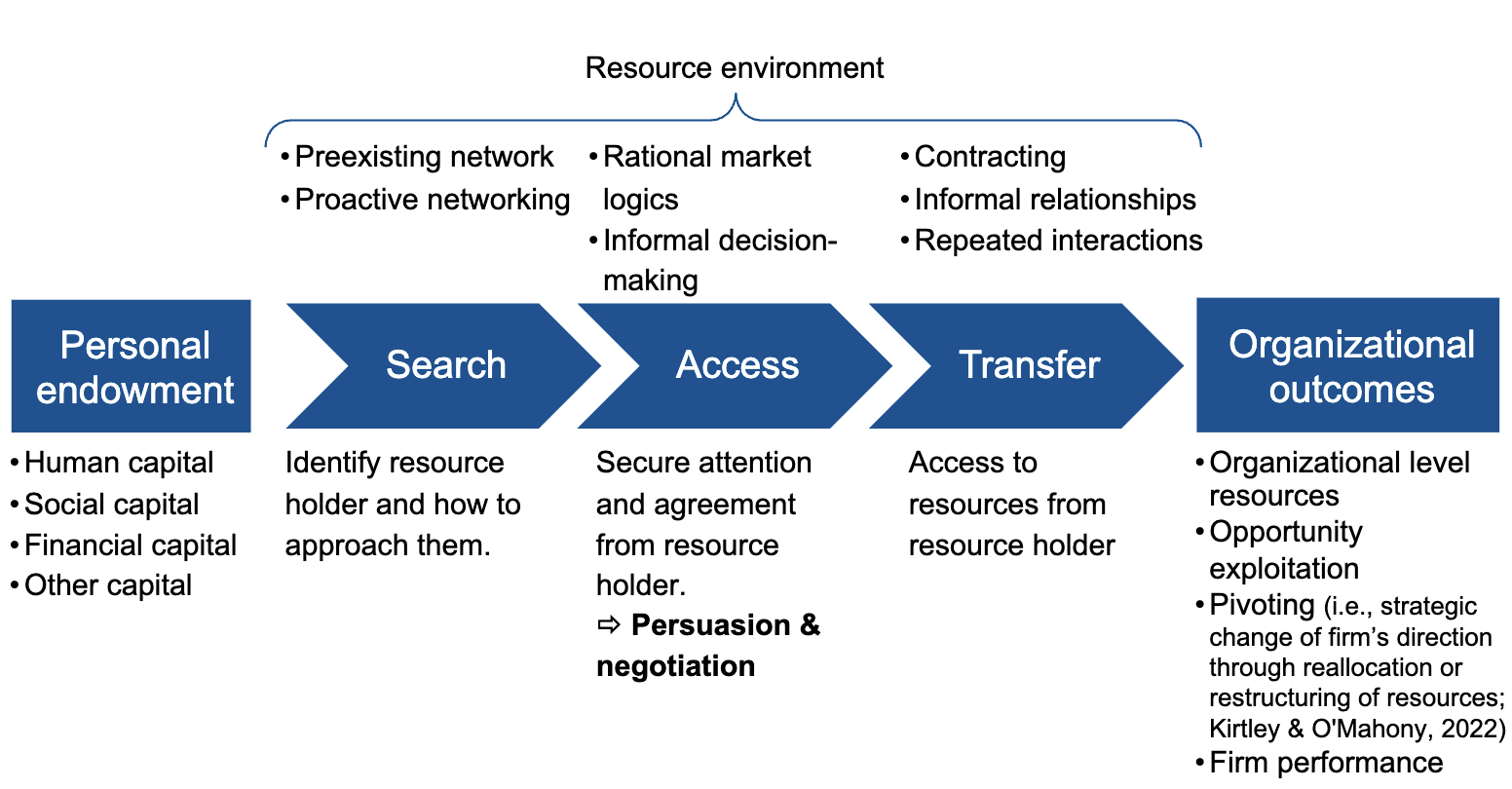
Start: Personal Endowment
Entrepreneurs often start with limited resources. They need to leverage their personal endowment, which includes (bird in hand):
- Human Capital (skills, knowledge, experience)
- Social Capital (networks, relationships)
- Financial Capital (savings, assets)
- Physical Capital (tools, equipment)
1. Search for Resources
Identify who has the resources needed (customers, partners, investors) and how to approach and engage with these resource holders.
Environment:
- Preexisting network
- Proactive networking
2. Access Resources
Secure commitments from resource holders through Persuasion & Negotiation.
Environment:
- Rational market logics
- Informal decision making
3. Transfer Resources
Access the resources to the venture (e.g., funding, expertise, equipment).
Environment:
- Contracting
- Informal relationships
- Repeated interactions
Outcome: Organizational Endowment
Transformed organizational level resources that the venture as can use for opportunity exploitation, pivoting, or scaling/performance.
Funding Stages
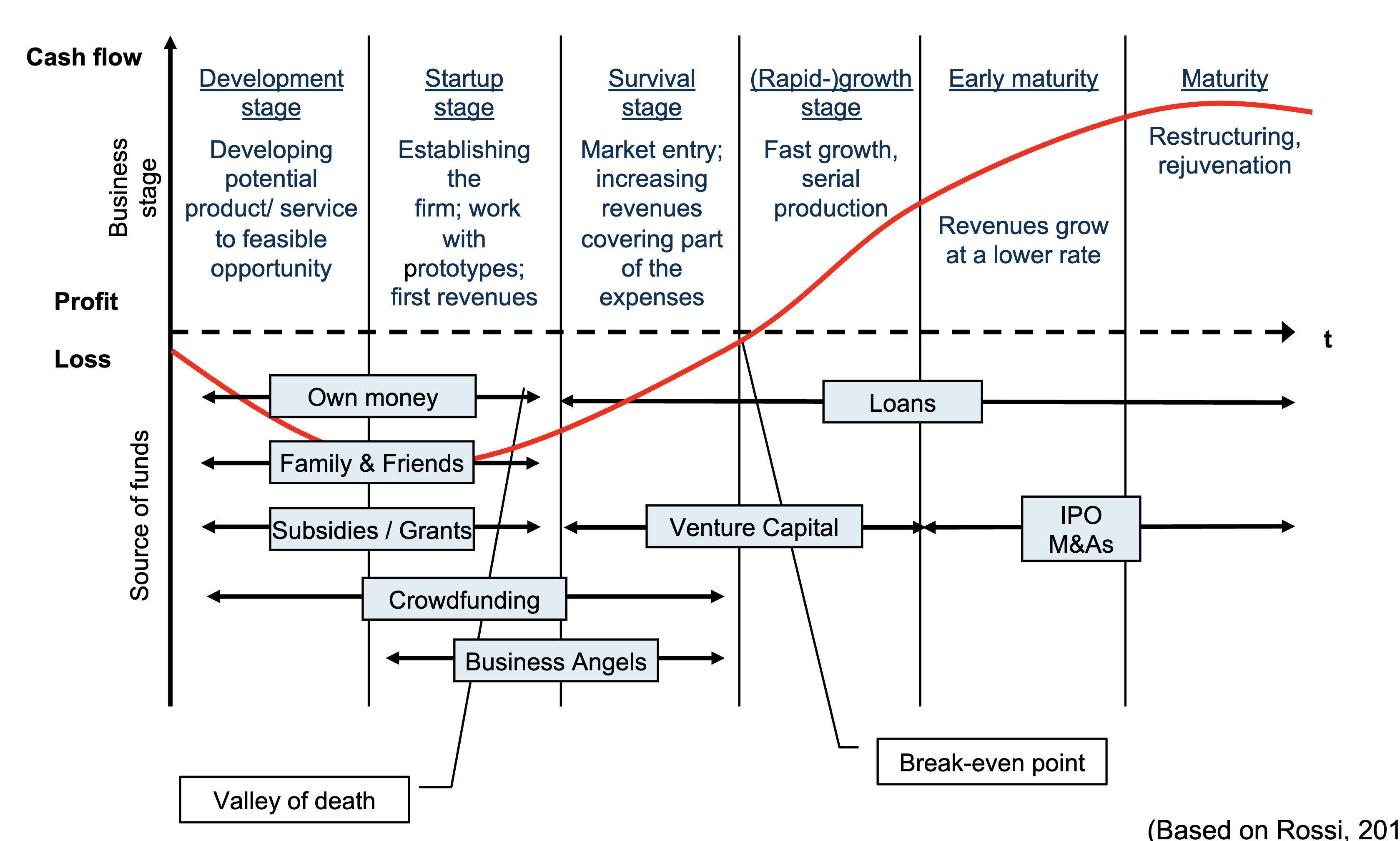
Ask questions: Inga vom Holtz @ UnternehmerTUM Funding for Innovators
Persuasion & Negotiation
Guiding people toward the adoption of your ideas, attitudes, or actions through social influence. (p. 8)
Persuasion works via:
- Psychological and social influence tactics
- Certain communication styles and elements (e.g. leadership)
To achieve this, our own goals, BATNA, and limits, as well as those of the other party, need to be clear. During the discussion, a compromise should be achieved through bargaining tactics. (p. 9)
BATNA — Best Alternative to a Negotiated Agreement
The best alternative to a negotiated agreement; the course of action you will take if no agreement is reached.
Example: Instead of accepting a distributor’s contract — is there another, comparable distributor; could you self-distribute? (p. 10)
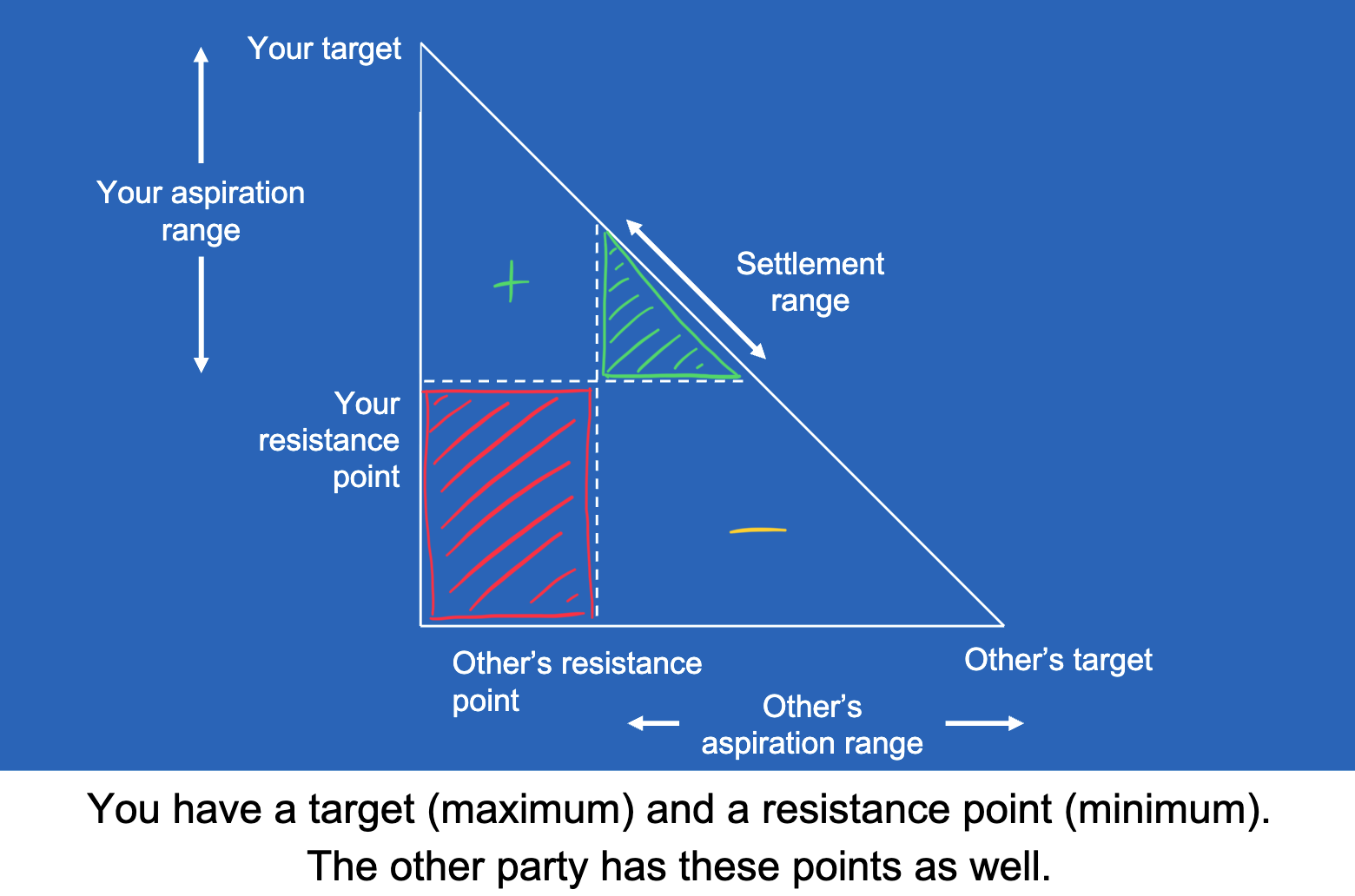
Bargaining Tactics
Bargaining implies a competitive situation; that all wins on one side result in losses on the other side. (p. 14)
Reciprocity and Commitment & Consistency can be used as tactics to increase the chance of agreement, however, they might also end cooperative business relationships.
Preparing Your Position
- Define a Goal: What do you want to achieve? This will help guide the discussion.
- What’s Your BATNA?: Knowing this can offer leverage and confidence during negotiations.
- Set Limits: What’s non-negotiable? What are possible trade-offs? What are unsatisfactory, minimum, good outcomes?
- Draft possible negotiation strategies: Consider different approaches based on the other party’s potential responses and interests, but do not risk the relationship. (p. 21)
Preparing Their Position
- Research Their Goals: What do they want to achieve? Understanding this can help find common ground and emotional bond and offer something the other party personally benefits from. Different groups have different interests, needs, and wants.
- Understand Their Concerns: Anticipating objections or reservations can help you prepare counterarguments and address them effectively during the negotiation – be proactive in preparing the discussion.
- Whats Their BATNA?: Knowing their alternatives can help you gauge their flexibility and willingness to compromise.
Examples: Is the distributor looking for specific products? Are customers using similar competing services? (p. 11) - Think of the future: Consider the long-term relationship and potential future interactions. Building rapport and trust can lead to more favorable outcomes in the long run.
Persuasion Techniques
Peripheral Route of Persuasion
When the other party has low ability or motivation to process information.
- Use peripheral cues (e.g., attractiveness, source credibility, number of arguments, emotions): Judgement will be based on these rather than the message content. Use social proof.
- Build rapport: Establish a connection to increase likability and trust. Be enthusiastic and confident, make the other party feel good about the interaction and the proposal.
- Highlight risks: Emphasize potential losses of not agreeing to your proposal; create scarcity.
- Tell a story: Speak quickly, using methaphors and personal stories. (p. 13)
Central Route of Persuasion
When the other party has high ability and motivation to process information.
- Use strong, logical arguments: Focus on the quality and strength of your arguments. Provide evidence and data to support your claims.
- Establish credibility: Demonstrate your knowledge and expertise. Use titles, affiliations, and endorsements from mentors or respected figures.
- Focus on benefits: Highlight the advantages and positive outcomes of agreeing to your proposal.
- Present balanced information: Use two-sided arguments that acknowledge potential pitfalls and explain how to address them.
- Be clear and concise: Avoid jargon and ensure your message is easy to understand. Visual aids can help make complex information more digestible. Encourage questions and follow up. (p. 13)
| Aspect | Peripheral Route | Central Route |
|---|---|---|
| Judgement | Peripheral cues (credibility, number of arguments) | Systematic assessment of central cues (quality, strength of argument) |
| Communicator | Rapport; confidence & enthusiasm; similarity to audience | Knowledge & experiences; prove trustworthiness (titles, affiliations, mentors) |
| Message | Ingratiating; emotional bond; emphasize risk of loss over benefits | Logical arguments; strong evidence for feasibility; focus on benefits |
| Mode | Speaking quickly; vivid descriptions; metaphors & personal descriptions | Two-sided (not extreme) information; present potential pitfalls & how to deal with them |
Reciprocity
A fundamental principle of human interaction where people feel obliged to return favors or concessions made by others. In negotiations, this can be leveraged to create a sense of obligation and encourage cooperation. (different example on p. 15)
Door-in-the-Face Technique
Making an extreme “anchoring” request that is likely to be refused, followed by a smaller, more reasonable request. The smaller request is more likely to be accepted because it seems like a concession.
Example: Asking a distributor for an exclusive contract (likely to be refused), then following up with a request for a standard distribution agreement. (p. 16)
That's-Not-All Technique
Presenting an initial offer and then improving it before the other party can respond. This creates a sense of getting a better deal and encourages acceptance.
Example: Cupcake with cookies for 1€ vs cupcake for 1€ plus “but wait, I’ll throw in cookies for free!” (p. 17)
Commitment & Consistency
The principle that people strive for consistency in their beliefs, attitudes, and behaviors. Once they commit to something, they are more likely to follow through to maintain consistency.
This pressure to commitment is most effective when the decision has been made publicly, involved effort, or is viewed as internally motivated. (p. 18)
Foot-in-the-Door Technique
Starting with a small request that is likely to be accepted, followed by larger requests. The larger request is more likely to be accepted because the person wants to remain consistent with their initial commitment.
Example: Asking a distributor to carry a small order of your product, then later requesting a larger order. (different example p. 19)
Low-Balling Technique
Getting agreement on a favorable initial offer, then changing the terms to be less favorable. The person is more likely to accept the new terms to remain consistent with their initial commitment.
Example: Agreeing on a distribution deal with favorable terms, then later informing the distributor of additional fees or requirements. (different example on p. 20)