Exam
09.02.2026, 08:00 – 10:00
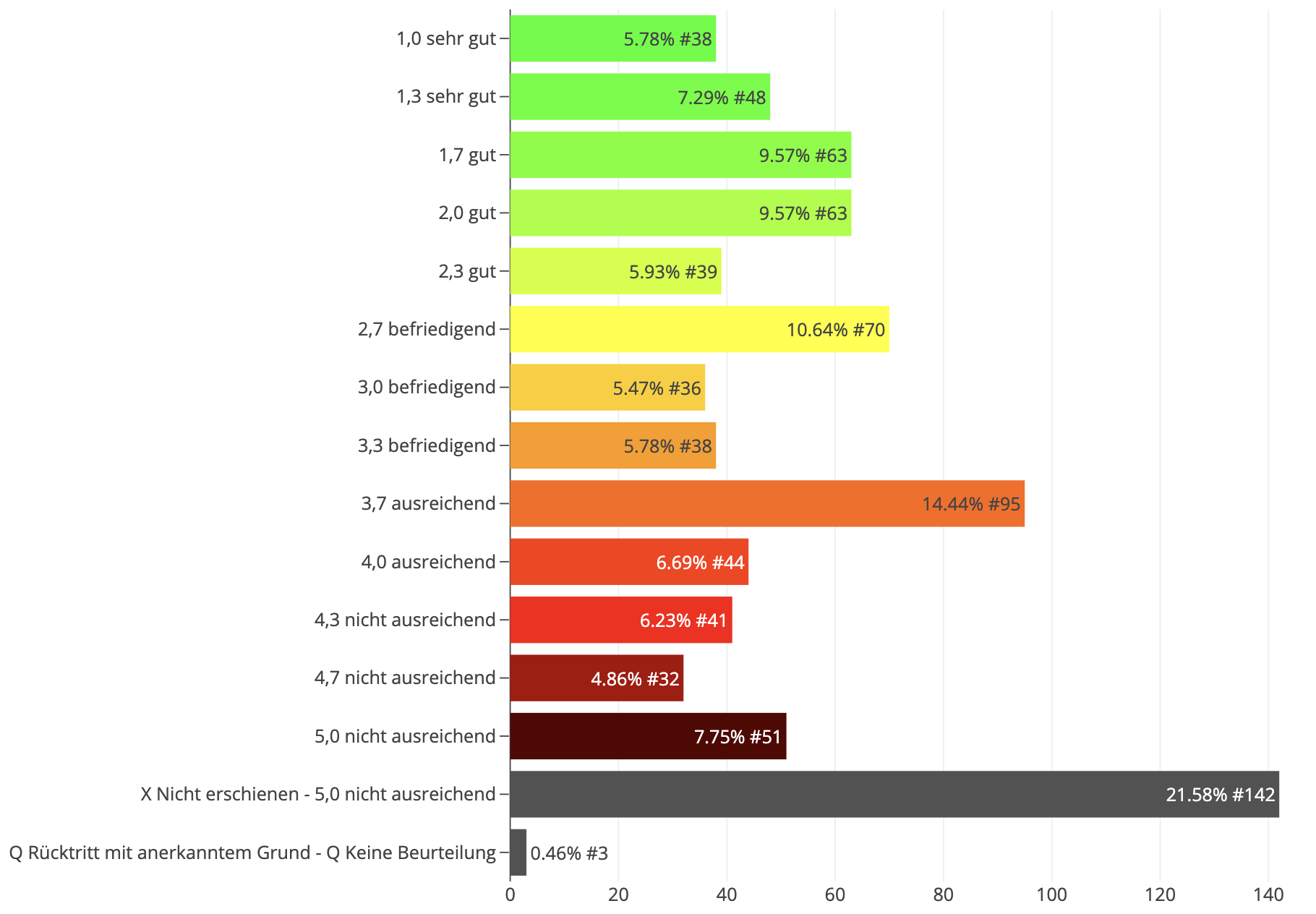
120min, Multiple ChoiceGrade Distribution WS25
Resources
Lecture
Mondays 15:00 – 16:30, 20.10. – 02.02.
Thursdays 11:30 – 13:00, 16.10. – 05.12.
Christian Feilcke
macher*
Topics
Microecononomics
- Specialization & Trade
- Consumption and Demand
- Production and Supply
- Perfect Competition
- Market Failure
Macroeconomics
What is Economics?
- Studies how individuals and societies allocate scarce resources to satisfy their wants. Fundamentally a choice problem under scarcity, involving the weighing of benefits and costs. (p. 3)
- Classic definitions:
- “A calculus of pleasure and pain” (Jevons, 1871)
- “A study of mankind in the ordinary business of life” (Marshall, 1890)
- “The science which studies human behaviour as a relationship between ends and scarce means which have alternative uses” (Robbins, 1932)
- Microeconomics: Analyzes the behavior of individuals and firms and their interaction on markets. (p. 4)
- Consumption and Demand
- Production and Supply
- Perfect Competition
- Market Failure
- Macroeconomics: Analyzes the behavior of the economy as a whole.
- Macroeconomic Indicators
- Economic Growth
- Economic Fluctuations
Stuff I was a little stuck on
Preparation Calculations
MRS/MRTS for common functions
Cobb-Douglas ( or ):
(obviously, the first term cancels for functions like )
Simplified CES ( or ):
Quasilinear ():
Chapter 1: Specialization & Trade
None, really. Maybe set up the comparative advantage table.
Chapter 2: Consumption and Demand (2)
- Marginal Rate of Substitution (MRS):
- Shortcuts see above
- Otherwise get from marginal utilities
- Optimal Consumption: , solve for one good, sub into budget constraint for the other
- Cobb-Douglas ():
- Simplified CES (): Let substitution elasticity . Then
- Quasilinear (): First determine using , then
Probably Useful
- Normal/Inferior, Regular/Giffen: Normal/Inferior is , Regular/Giffen is
- Cobb-Douglas: Both goods are always normal and regular.
- Quasilinear: Good 1 is normal if is concave (), inferior if convex; Good 2 is always normal. Both regular.
Chapter 3: Production and Supply (2)
- Marginal Rate of Technical Substitution (MRTS):
- Shortcuts see above
- Otherwise get from marginal products
- Optimal Production: Set , solve for one input, sub into for the other, then backsub into first
- For Simplified Cobb-Douglas ():
- For Simplified CES ():
Probably Useful
- Returns to Scale: Depends on extracted factor : Decr. < 1 < Increasing
- Simplified CES:
- Cobb-Douglas:
- Thresholds:
- Short-Run: to get or
- Long-Run: to get or
- Threshold shortcut: If the cost function is of the form , then
Chapter 4: Perfect Competition (5)
- Marginal Cost: Derivative of
- Average Cost, Average Variable Cost:
- Individual Supply: Set , solve for
- Break-Even Quantity: Set , solve for (this implies and therefore the long-run exit)
- Equilibrium Price (long-run):
Chapter 5: Market Failure
Monopolies
- Marginal Cost: Derivative of
- Price Function: Set , solve for
- Revenue and Marginal Revenue: and its derivative
- Equilibrium Quantity: Set , solve for
- Equilibrium Price:
Probably Useful
- Socially Optimal:
- Fair Return:
Externalities
- Marginal Cost: Derivative of
- Social Marginal Cost:
- Price Function: Set , solve for
- Optimal Quantity: For individual, , for welfare , solve for , assume .
Public Goods
- Marginal Cost: Derivative of
- Sum of Marginal Benefits:
- Optimal Quantity For individual, , for efficient/welfare,
Chapter 6: Macroeconomic Indicators
None, really.
Chapter 7: Economic Growth (1/4)
- Output per Worker: with
- Cobb-Douglas Shortcut (:
Shortcuts for Cobb-Douglas (
- Golden Rule Saving Rate for CD:
- Capital per Worker for CD:
- Consumption per Worker for CD:
Chapter 8: Economic Fluctuations (3)
- IS Curve: , solve for
- LM Curve: , solve for
- IS-LM Equilibrium: Set from IS equal to from LM, then solve for whatever you need
Probably Useful
- Goods Market Marginal Government Spending Multiplier: where
- Tax Multiplier is the negative of the government multiplier times :
- For general impacts of changes in //, [see the table](obsidian://adv-uri?vault=TUM&filepath=Principles%20of%20Economics%2FEconomic%20Fluctuations.md&block=nb1aa1](obsidian://adv-uri?vault=TUM&filepath=Principles%20of%20Economics%2FEconomic%20Fluctuations.md&block=d2k8t1) (section link for web version)